Your cat turns up its nose at yet another can of premium food, and you wonder whether there's a better way to feed your cat. The answer lies in an acronym that has been revolutionizing the world of animal nutrition for several decades: BARF — Biologically Appropriate Raw Food. This is not a passing fad. It's a return to what nature designed for the feline body — raw food, served in a controlled and precisely balanced way.
This guide walks you through everything you need to know about BARF for cats: from philosophy and composition, through the key nutrients, all the way to practical tips — how to start and what mistakes to avoid.
What is the BARF diet?
The term BARF was coined by the Australian veterinarian Dr. Ian Billinghurst, author of the groundbreaking book Give Your Dog a Bone (1993), later expanded in The BARF Diet (2001). Although Billinghurst originally focused on dogs, the principles were quickly adapted to feeding cats — taking into account their unique needs as obligate carnivores.
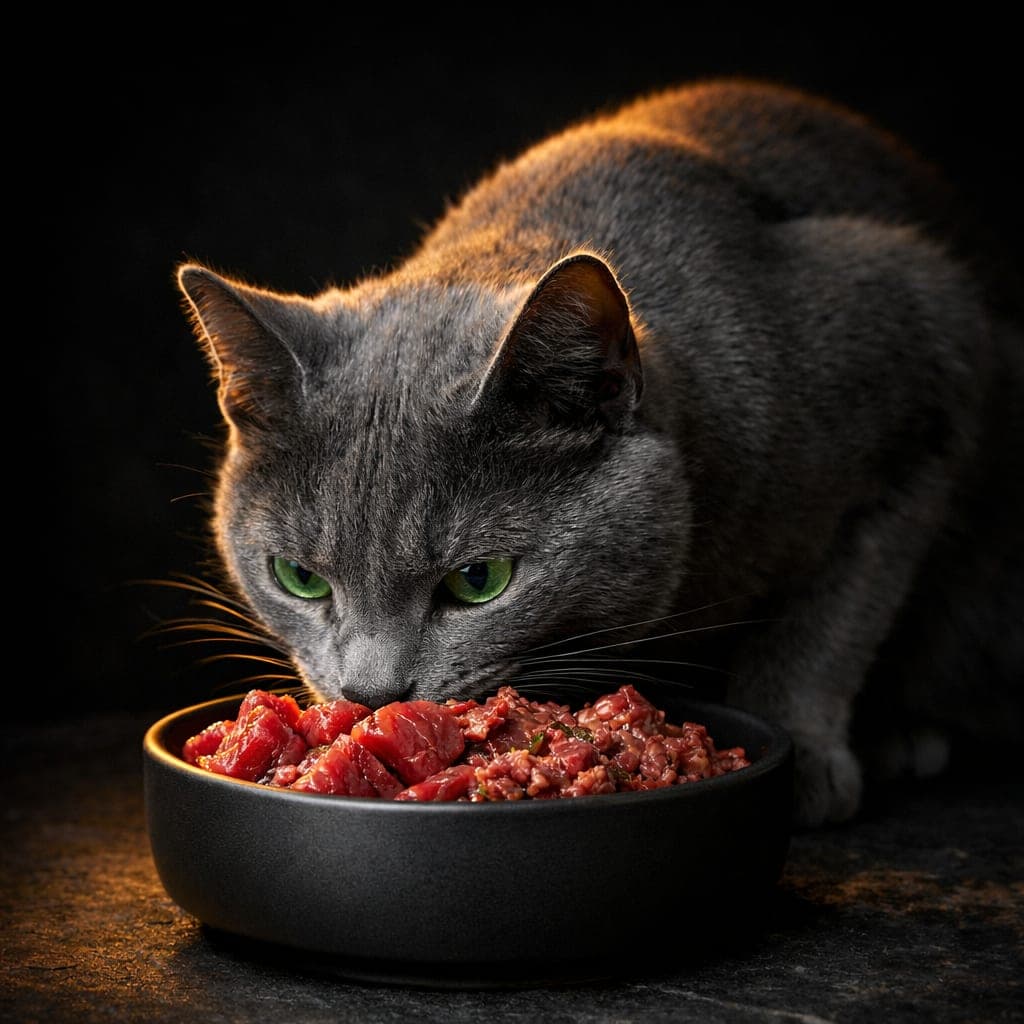
The acronym BARF stands for Biologically Appropriate Raw Food. The philosophy is simple and elegant: feed your cat what it would eat in nature, but do it in a controlled, balanced, and safe way. In practice — raw meat, bone, internal organs, and precisely chosen supplements that guarantee nutritional completeness.
Evolution is the best nutritionist. Millions of years shaped the cat's digestive system to process raw meat and bone to perfection. No food factory can replace what nature designed.
— Billinghurst, 1993
The key difference between BARF and other approaches to raw feeding (RMB, Whole Prey) lies in precision. BARF is not about tossing your cat a piece of meat and hoping for the best. It's a system in which every ingredient is weighed, every mineral calculated, and every proportion controlled. A scientific approach to natural feeding.
The composition of the BARF diet for cats
Muscle meat (60-70%)
The foundation. Muscle meat provides high-quality protein, fats, B vitamins, and the amino acids essential for the proper functioning of the feline body. The most commonly used: chicken, turkey, rabbit, beef, lamb. Rotation is important — different species provide a broader nutritional profile and reduce the risk of allergies.
Meat is served in chunks or coarsely ground — never as a fine paste. Cats need a texture that engages the jaws and teeth. This is not only oral hygiene, but also mental stimulation and the hunting instinct.
Raw bone (5-15%)
A natural source of calcium and phosphorus — minerals crucial for the skeleton, teeth, and muscle function. In BARF, bone is most often served ground (meat-on-bone through a grinder) or as soft, cartilaginous bones — chicken necks, quail wings, rabbit ribs.
A proportion of 5-15% calculated as pure bone (without meat). Too little = a calcium deficiency. Too much = constipation and hard, crumbly stools. This is the element requiring the greatest precision.
Heart (10-15%)
Although technically a muscle, the heart occupies a separate place in BARF. The reason? Taurine. Heart — chicken and turkey especially — is one of the richest natural sources of taurine. Beyond that, it provides coenzyme Q10, heme iron, and B vitamins.
Internal organs (5-10%)
Natural multivitamins — nutrient-dense tissues that deliver vitamins and minerals in the form most readily absorbed by the cat:
- Liver — the most powerful source of vitamin A, B vitamins (especially B12), and iron. A maximum of 5% of the diet. Excess vitamin A is toxic.
- Kidney — rich in B vitamins, selenium, and iron.
- Spleen, lung, brain — additional organs that enrich the nutritional profile. Brain is especially rich in DHA.
The key rule: a variety of organs. Don't rely on liver alone. Ideally 2-3 different organs from different species.
Fats
Fat is not the enemy — it's the main source of energy for a cat. Unlike humans, cats draw most of their calories from fat, not carbohydrates. Meat with a natural layer of fat, poultry skin, fish oils (omega-3) — essential elements.
Key nutrients
Taurine — the amino acid a cat can't survive without
This is the absolute priority. Cats cannot synthesize taurine on their own in sufficient amounts — unlike dogs and humans. A deficiency leads to dilated cardiomyopathy, retinal degeneration (blindness), and reproductive problems.
734 mg/kg
The norm is about 734 mg of taurine per kilogram of a cat's body weight per day. The best natural sources: heart (chicken ~60 mg/100g), dark turkey meat, seafood. In practice, most BARF diets require additional supplementation.
The calcium-to-phosphorus ratio (Ca:P)
The most often neglected, yet simultaneously the most critical, parameter. The ideal ratio is Ca:P = 1.15:1, with a safe range of 1.0-1.5:1. Muscle meat is rich in phosphorus and poor in calcium. Without bone or a calcium supplement, the diet will have inverted proportions — which leads to bone demineralization, pathological fractures, and nutritional hyperparathyroidism.
Never muscle meat alone
Feeding a cat exclusively muscle meat, without a source of calcium, is one of the most dangerous beginner mistakes. Meat has a Ca:P of about 1:15-1:20. Without calcium, the body starts "borrowing" it from its own bones — and within a few weeks the cat ends up with pathological fractures.
Vitamin A
Cats cannot convert beta-carotene from plants — they need the ready-made, animal form (retinol). The main source: liver. The norm is ~6120 IU/kg of body weight. Both deficiency and excess are dangerous — hence the strict limit of 5% liver in the diet.
Vitamin D
Cats do not synthesize vitamin D from sunlight (unlike humans). Sources: oily fish (salmon, sardines), cod liver oil, egg yolks. The norm is ~92 IU/kg of body weight.
Iodine
Essential for the thyroid. The norm is 184 µg/kg of body weight. The best sources: sea fish and seaweed (kelp). A deficiency = hypothyroidism. An excess = hyperthyroidism. Precise dosing is crucial.
Omega-3 (EPA + DHA)
EPA and DHA from sea fish support the skin, coat, joints, and nervous system. The norm is ~200 mg/kg of body weight. Salmon or sardine oil is the standard supplement.
Vitamin E
An antioxidant; it protects cells from oxidative stress. It is especially important with fish oils, which increase the requirement for E. The norm is ~37 IU/kg of body weight.
How to start with BARF?
Step 1: A single protein source
Chicken is the gold standard to start with. Readily available, cheap, well tolerated, and it offers a wide choice of cuts: thighs, heart, liver, necks. A single species = easier monitoring of reactions and ruling out allergies.
Step 2: A simple recipe
| Ingredient | Proportion |
|---|---|
| Boneless chicken thighs, with skin | 65% |
| Chicken heart | 10% |
| Chicken liver | 5% |
| Kidney or another organ | 5% |
| Chicken necks (ground) | 10% |
| Additional fat / skin | 5% |
| Supplements | taurine, fish oil, vit. E, iodine (kelp) |
This is a base recipe to refine in the calculator. It doesn't have to be perfect from day one.
Step 3: Use a calculator
Calculating Ca:P, taurine, and vitamins by hand is possible, but impractical and error-prone. A BARF calculator is not a luxury — it's a necessity. It will instantly show you whether the recipe is balanced, where the deficiencies are, and how to fill them.
Step 4: Gradually add proteins
Once your cat tolerates chicken for 2-3 weeks (regular stools, good energy, no vomiting), add new sources: turkey, rabbit, beef, lamb, fish. Introduce each meat separately, over a minimum of one week. Protein rotation is the key to a complete nutritional profile.
Step 5: Portion in advance
Experienced feeders prepare food once every 2-4 weeks. They mix meat, bone, and organs in the right proportions, portion it, and freeze it. Daily feeding = take out a portion in the evening, serve it in the morning after thawing in the fridge.
Common beginner mistakes
5%
The most common beginner mistake is exceeding this threshold. Liver is so rich in vitamin A that even 10% of the diet leads to vitamin A toxicity — bone pain, joint stiffness, and in extreme cases fusion of the spine.
- No calcium / a bad Ca:P — feeding muscle meat alone without bone and without a calcium supplement. Meat has a Ca:P of 1:15-1:20. Without calcium, the body "borrows" it from its own bones — pathological fractures within a few weeks.
- No taurine supplementation — even a diet rich in heart may not cover the full requirement, especially in active cats. Additional synthetic taurine is safe (any excess is excreted in the urine).
- Feeding muscle meat exclusively — the foundation, but not the whole diet. Without organs, bone, and supplements it is dramatically incomplete.
- Mixing BARF with dry food — raw food digests faster than kibble. Together in one meal, they slow down the digestion of the meat, with a risk of fermentation and gas. Gradually, but not together.
- Skipping freezing — a minimum of 72 hours at -20°C eliminates most parasites, including Toxoplasma gondii. Especially important with pork and game.
- No variety — feeding a single species of meat for months leads to deficiencies. Rotate a minimum of 3-4 sources.
Tools and calculators
The BARF diet requires precision. Ca:P, taurine, the liver limit, omega-3, vitamin D, iodine — a lot of variables. Manual calculations are possible, but tedious and error-prone. That's why a BARF calculator is essential gear for the informed owner.
A good tool should: contain an extensive ingredient database with a full nutritional profile, automatically calculate Ca:P and flag deviations, account for the norms for taurine, vitamins, minerals, and fatty acids, offer automatic balancing with supplement suggestions, and let you save and edit recipes.
With this in mind, the mrumi BARF Calculator was created — a tool with a database of 297 ingredients, automatic balancing of Ca:P, taurine, and 12 categories of supplements. Step by step through the process of building a recipe — from your cat's data to a finished, balanced meal.
Summary
The BARF diet is the gold standard of controlled raw feeding for cats. It combines the wisdom of evolution with the precision of modern nutritional science. It gives the cat what its body is genetically adapted to — raw meat, bone, and organs — in a form that is safe, balanced, and complete.
Does it require more effort than opening a can? Yes. Does it require knowledge? Definitely. But the results speak for themselves: a glossy coat, clean teeth, strong muscles, optimal weight, fewer vet visits, and a cat that runs enthusiastically to its bowl.
You don't need to know everything at once. Start with a simple chicken recipe, use a calculator, observe your cat. With every week you'll grow more confident. And your cat will repay you with what it does best — purring, energy, and years of health.
Because at the end of the day, BARF is not complicated science. It's feeding a cat like a cat.
Sources
- Billinghurst I. (1993). Give Your Dog a Bone: The Practical Commonsense Way to Feed Dogs for a Long Healthy Life. Self-published.
- Billinghurst I. (2001). The BARF Diet: Raw Feeding for Dogs and Cats Using Evolutionary Principles. Warrigal Publishing.
- National Research Council. (2006). Nutrient Requirements of Dogs and Cats. National Academies Press.
- Hayes K.C., Carey R.E., Schmidt S.Y. (1975). Retinal degeneration associated with taurine deficiency in the cat. Science, 188(4191), 949-951.
- Pion P.D., Kittleson M.D., Rogers Q.R., Morris J.G. (1987). Myocardial failure in cats associated with low plasma taurine: a reversible cardiomyopathy. Science, 237(4816), 764-768.
References
- Billinghurst, I. (1993). Give Your Dog a Bone: The Practical Commonsense Way to Feed Dogs for a Long Healthy Life, Self-published
- Billinghurst, I. (2001). The BARF Diet: Raw Feeding for Dogs and Cats Using Evolutionary Principles, Warrigal Publishing
- National Research Council (2006). Nutrient Requirements of Dogs and Cats, National Academies Press
- Hayes, K.C., Carey, R.E. & Schmidt, S.Y. (1975). Retinal degeneration associated with taurine deficiency in the cat, Science, 188(4191), 949-951
- Pion, P.D., Kittleson, M.D., Rogers, Q.R. & Morris, J.G. (1987). Myocardial failure in cats associated with low plasma taurine: a reversible cardiomyopathy, Science, 237(4816), 764-768
Frequently asked
How does BARF differ from just plain raw meat?
BARF is a system, not improvisation. Every ingredient has a defined proportion, every mineral is calculated, the proportions are controlled. Meat, bone, organs, supplements — all of it to recreate the complete nutritional profile of prey.
Can I feed my cat muscle meat alone?
No. Meat has a Ca:P ratio of about 1:15 — inverted relative to the norm of 1.15:1. Without bone or a calcium supplement, the body starts borrowing it from its own skeleton, which leads to pathological fractures within a few weeks.
How much liver can I give my cat?
A maximum of 5% of the diet. Liver is a concentrate of vitamin A, an excess of which is toxic — it leads to vitamin A toxicity with bone pain, joint stiffness, and in extreme cases fusion of the spine.
Is heart enough as a source of taurine?
Often not. The norm is ~734 mg of taurine per kg of body weight per day, while chicken heart has ~60 mg/100g. Most BARF diets require additional supplementation with synthetic taurine — any excess is safely excreted in the urine.
Why freeze raw meat before serving?
Freezing for a minimum of 72 hours at -20°C eliminates most parasites, including Toxoplasma gondii. This is especially important with pork and game.