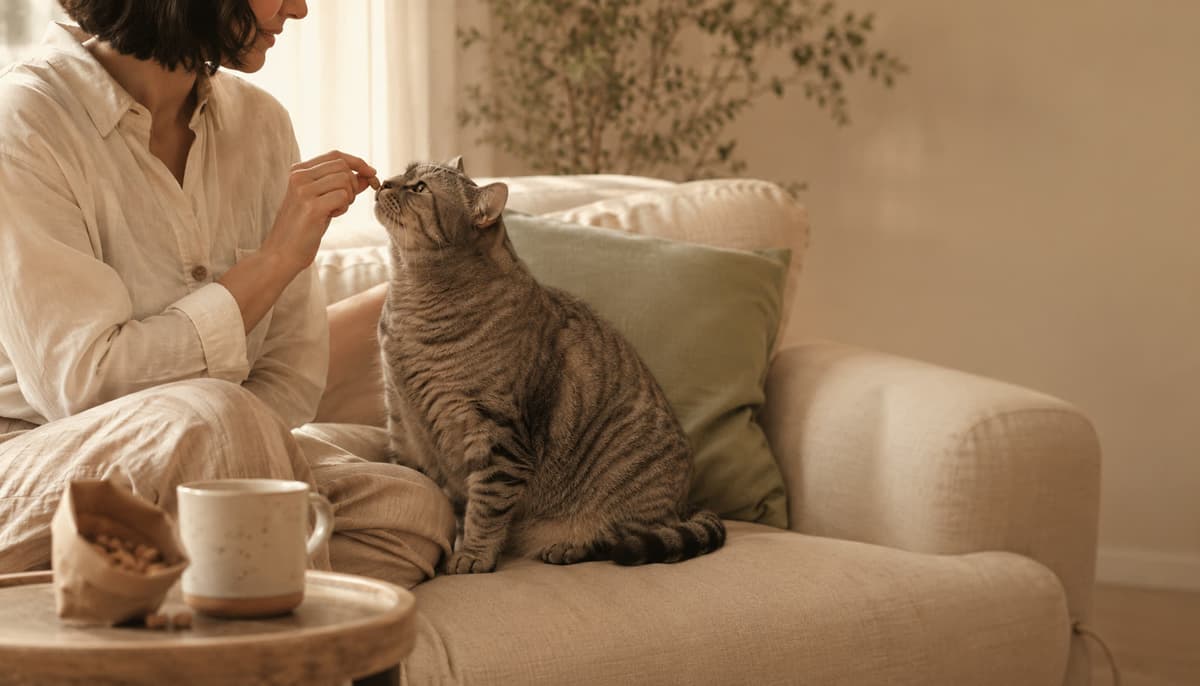
If your cat could do its own shopping, what would it put in the basket? Dry food with rice and corn? A pouch with "gravy" and 4% meat? Or maybe two kilos of hearts, half a kilo of liver, and a handful of bones?
Two major scientific studies answered this question unequivocally. Their results should change, once and for all, the way you think about feeding your household predator.
Study one: what do cats eat in the wild?
In 2011, a team of researchers (Plantinga, Bosch, and Hendriks) set out to determine what the natural diet of cats looks like — not in theory and not on a food label, but in nature. They analyzed 27 studies from four continents, covering a total of 6666 samples of stomach, intestinal, and fecal contents of free-roaming feral cats.
6666
The broadest meta-analysis of a cat's natural diet — from four continents, a total of six thousand six hundred and sixty-six stomachs of feral cats.
The results? Cats in the wild eat mainly mammals (78%) — chiefly rodents and rabbits. Add to that birds (16%), while reptiles and insects together make up just under 5%. Fish? Less than half a percent. Plants? Trace amounts, with no nutritional significance whatsoever.
The macronutrient profile of a cat's natural diet
| Component | % of dry matter | % of energy |
|---|---|---|
| Protein | 62.7% | 52% |
| Fat | 22.8% | 46% |
| Carbohydrates (NFE) | 2.8% | 2% |
| Ash (minerals) | 11.8% | — |
Read those numbers again. Two percent of energy from carbohydrates. Not twenty, not thirty — just two. All the rest is protein and fat from animal tissue.
The moisture content of such a natural diet is about 70%, because prey is made up mostly of water. Cats in the wild barely drink from bowls or puddles — they obtain all the water they need from their food.
Free-roaming cats draw 52% of their energy from protein, 46% from fat, and only 2% from carbohydrates. This is the profile to which the cat's metabolism adapted over millions of years of evolution.
— Plantinga, Bosch & Hendriks, 2011
Minerals: Ca:P in nature = 1.51
The study also revealed something extremely important about minerals. The calcium-to-phosphorus ratio (Ca:P) in the natural diet came out to 1.51 : 1 — a value clearly higher than the minimum recommended by nutritional standards (about 1.0-1.2). Cats in the wild eat whole prey, skeleton included, and bone is a powerful calcium carrier. Their bodies have adapted evolutionarily to a high level of this element.
Study two: what does a cat choose when it has a choice?
One could argue that wild cats eat whatever they happen to catch, not what they would want. Maybe, given a choice, they'd reach for rice or corn?
That's exactly what researchers at the WALTHAM Centre for Pet Nutrition set out to test. In the same year (2011), Hewson-Hughes's team ran 9 experiments on adult domestic cats. They were offered a kind of "smorgasbord" — foods with wildly different macronutrient proportions — and allowed to choose for themselves what and how much to eat.
52 / 36 / 12
The profile that domestic cats choose when they have free rein. Identical to that of wild hunters — instinct mimics evolution.
The carbohydrate ceiling: ~300 kJ per day
The most groundbreaking finding of this study concerned the cats' behavior toward carbohydrates. They have an absolute biological limit — the so-called carbohydrate ceiling — of about 300 kJ per day.
A cat would rather starve than exceed the limit
When cats were given only high-carbohydrate food, they preferred to drastically cut back on eating and go hungry rather than exceed this limit. Intake dropped to 500 kJ/day against a requirement of 1000 kJ. It's a metabolic necessity, not a whim.
A cat's anatomy explains this mechanism directly:
- No salivary amylase — no enzyme for the preliminary digestion of starch
- Negligible pancreatic amylase — many times lower than in dogs
- No hepatic glucokinase — a key enzyme of glucose metabolism
- Limited de novo lipogenesis — a cat doesn't convert carbs into stored fat
- No sweet-taste receptor — it literally can't taste sweetness
When a cat eats too many carbohydrates, the undigested starch reaches the large intestine, where it undergoes unnatural bacterial fermentation. The result? Acidification of the gut, microbiome disruption, and digestive problems.
What does this mean for your cat?
1. Check the food label. If you see rice, corn, wheat, potatoes, or peas among the top five ingredients, you're feeding your cat a metabolically alien diet. Typical dry food supplies 30-50% of its energy from carbohydrates. A cat's target: 2-12%.
2. Remember moisture. Natural prey is 70% water; dry food, 8-10%. A cat fed kibble lives in a state of chronic, mild dehydration, which mercilessly burdens its kidneys.
3. Mind the omega-6 / omega-3. In the natural diet the ratio is ~2:1; in commercial foods it's often 5:1 to 17:1 — which promotes inflammation.
The BARF diet vs evolution
| Parameter | Nature | Cat's target | BARF | Dry food |
|---|---|---|---|---|
| Protein (% of energy) | 52% | 52% | 45-55% | 25-35% |
| Fat (% of energy) | 46% | 36% | 35-50% | 25-40% |
| Carbohydrates (% of energy) | 2% | 12% | 1-5% | 30-50% |
| Moisture | ~70% | — | ~70% | 8-10% |
The BARF diet perfectly recreates the profile that evolution "programmed" into the feline metabolism. Not because it's a fad, but because it is absolutely consistent with the biology of this species.
Summary
Two powerful and independent studies reached an identical conclusion: the optimal feline diet is a hefty dose of animal protein, moderate fat, and almost no carbohydrates.
Your cat has a built-in internal calculator that protects it from plant-based fillers through the so-called carbohydrate ceiling. The next time someone tells you that "dry food is complete and balanced," remember these three numbers: 52 / 36 / 12.
You can't cheat chemistry, math, or evolution.
Sources
- Plantinga E.A., Bosch G., Hendriks W.H. (2011). Estimation of the dietary nutrient profile of free-roaming feral cats: possible implications for nutrition of domestic cats. British Journal of Nutrition, 106, S35–S48.
- Hewson-Hughes A.K., Hewson-Hughes V.L., Miller A.T., Hall S.R., Simpson S.J., Raubenheimer D. (2011). Geometric analysis of macronutrient selection in the adult domestic cat, Felis catus. Journal of Experimental Biology, 214(6), 1039–1051.
Frequently asked
Will my cat survive on dry food alone?
It will survive, but in a state of chronic, mild dehydration (dry food has 8-10% water, natural prey 70%). On top of that, it gets 30-50% of its energy from carbohydrates, which a cat's physiology doesn't handle optimally. In the long term, this raises the risk of kidney disease and diabetes.
What is the ideal ratio of protein, fat, and carbohydrates for a cat?
According to the studies by Plantinga (2011) and Hewson-Hughes (2011) — 52% of energy from protein, 36% from fat, a maximum of 12% from carbohydrates. It's an "internal compass" that a cat recreates when given a choice.
What is the "carbohydrate ceiling"?
A biological limit of ~300 kJ of carbohydrates per day that a cat won't exceed. Researchers observed that cats prefer to drastically cut back on eating and go hungry rather than eat more carbs. It stems from the absence of salivary amylase, low pancreatic amylase, and the absence of hepatic glucokinase.
Is BARF the only good option?
No — BARF comes closest to the biologically natural profile (1-5% carbs, 70% moisture), but well-prepared wet foods with a high protein share and low carbohydrates are also fine. The worst from an evolutionary standpoint is typical grain-based dry food.