
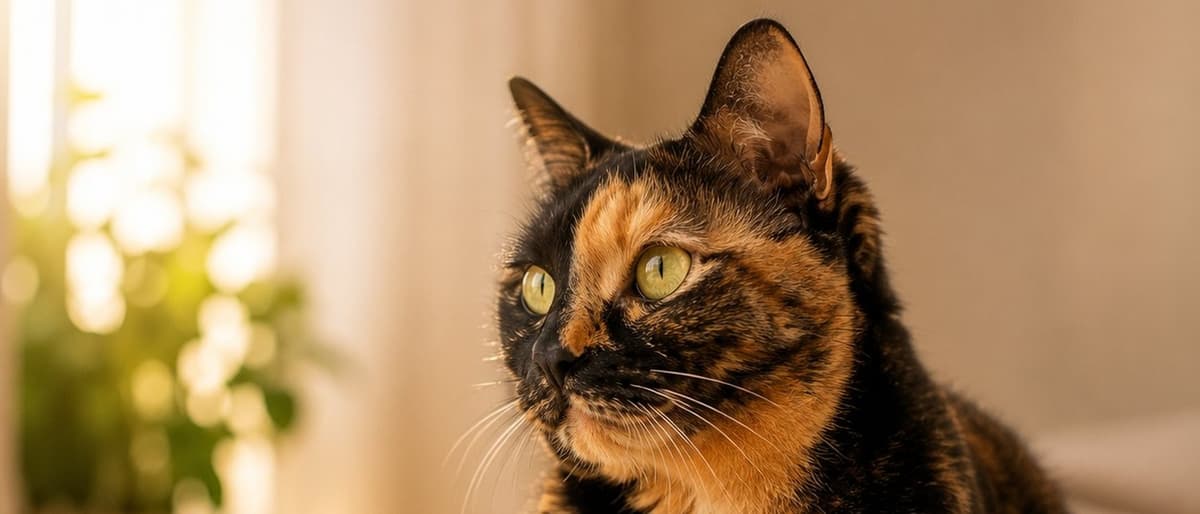
Look at any cat — a ginger tabby, a black „panther,” a tortoiseshell female wearing three colors at once, a cream British Shorthair. And now the surprising truth: that entire palette comes from just two pigments. The rest is pure genetics — a set of switches deciding how much of each pigment is made, where and when. Some of them were cracked decades ago. One — the gene behind ginger fur — resisted science for over a hundred years and only gave in in 2025.
I've gathered here only what follows from peer-reviewed genetic research (that is, work rigorously checked before publication by other, independent experts in the field) — from pigment chemistry to retroviruses hidden in the feline genome. No myths, but a handful of facts that will change the way you look at your own cat.
The two pigments every cat is built from
All the color of fur, skin and eyes is the work of specialized cells — melanocytes — which produce a pigment called melanin. Or rather not one pigment, but two kinds: eumelanin (the dark one, giving black and brown) and pheomelanin (the lighter one, giving ginger, yellow and creams).
2
Both pigments come from the same building block, and their production is kick-started by the same enzyme — tyrosinase. What sets them apart is mainly which „pathway” the reaction takes.
Which pigment is made in greater amounts is decided by a kind of molecular switch in the melanocyte. When the pathway runs at high gear, the cell makes dark eumelanin; when it slows down, it shifts to ginger pheomelanin. All the other „color genes” are, in essence, modifiers of this one basic choice.
Compute your cat's diet — BARF calculatorOpen calculatorGinger: the puzzle solved only in 2025
The most famous feline switch is the ginger gene. It has one remarkable feature: it sits on the X chromosome. That's why ginger color is inherited differently in females and males. A male has only one X chromosome. Either it carries the „ginger” version — in which case the cat is fully ginger — or it doesn't. A female has two X chromosomes, so she can be ginger-ginger, not ginger at all, or carry one of each. And this is where the magic begins.
In every cell of a female mammal's body, one of the two X chromosomes is randomly switched off at an early stage of embryonic development. This is a natural process called X-chromosome inactivation (or lyonization) — one chromosome is permanently shut down and „packed away” so the body doesn't double the amount of proteins it makes. In a female cat that has a „ginger” X and a „non-ginger” X, some skin cells switch off one and some the other — and a mosaic of ginger and black patches is born. This is how a tortoiseshell arises, and with added white, a calico (a tricolor female).
A tortoiseshell is a living map of X inactivation
Every ginger and every black patch on a tortoiseshell cat is a record of a decision her cells made back in fetal life: which X chromosome to switch off. That's why no two tortoiseshells ever look exactly alike.
The same arithmetic means that roughly three in four ginger cats are male. Tortoiseshell males are an enormous rarity (and usually sterile). Rarer still, such a male is a chimera — an organism formed by the merging of two separate embryos in the womb. Biologically, it's as if two feline twins fused into a single cat.
Although ginger had been known for a long time, the gene eluded scientists. The breakthrough came in May 2025, when teams from Stanford and Japan pinpointed the cause: a tiny deletion — a mutation in which a fragment of DNA „drops out” — near the ARHGAP36 gene. This deletion makes the gene switch on in pigment cells and reprograms them to produce ginger pheomelanin.
over 900 years
All the ginger cats studied carry the same change in their DNA, which indicates that the mutation arose once, in a single cat, and spread through the population.
Black, chocolate, cinnamon — and their diluted versions
Now that we have ginger, let's return to the dark eumelanin. It's modified by another gene that creates a series of shades: black, chocolate (brown) and cinnamon.
On top of that comes yet another gene — the dilution gene (MLPH). It doesn't change the type of pigment, only how it's packed into the hair. Instead of spreading evenly, it forms clumps. As a result, the color looks lighter. And so black is lightened to blue (gray), chocolate to lilac, cinnamon to fawn, and ginger to cream. This is where the „blue” British cats come from, for example.
Stripes and spots: deep down, every cat is a tabby
Here's a surprising fact: every cat's default state is stripes (broadly known as the tabby coat). Even a uniformly black cat (with a so-called solid, completely smooth coat) physically has those stripes. A separate gene simply paints its pattern over in dark. In strong sunlight you can often see the show-through stripes, called ghost markings. Because this gene doesn't act on ginger pigment, there's no such thing as a uniformly ginger cat without a trace of striping.
The type of pattern is decided by the Taqpep gene: the dominant version gives a mackerel pattern (the tiger look — narrow vertical stripes resembling a fish skeleton), while the recessive version gives a blotched pattern (the classic coat, with broad, marbled swirls on the sides).
The pattern forms before color appears
The map of the future stripes is drawn into the embryo's skin before pigment cells even arrive there. In other words: a cat has its coat pattern laid out before that coat even exists.
White is a whole other story (and not albinism)
All the genes above decided which color would form. White removes color. Dominant white in cats is caused by an ancient retrovirus built into the DNA. Depending on the variant, it gives white patches (including the charming cats „in socks” or the tuxedo coat — penguin-like, looking like a black-and-white suit) or complete, dominant white.
The dominant version of the white gene (designated W in genetics) is epistatic. Epistasis is, in other words, the phenomenon of masking — this particular white gene acts like a thick layer of paint that covers up the effects of all the other color genes underneath.
The same gene also has pleiotropic effects — meaning a single gene influences several completely different and seemingly unrelated traits of the organism. The pigment cells missing here from the skin and fur are also needed for the inner ear to work. Their absence means that complete white and blue eyes come with a raised risk of deafness. The gene does not, however, have full penetrance — meaning that merely having the gene does not guarantee the trait will appear (which is why not every blue-eyed white cat goes deaf).
A white cat is not an albino
White is so-called leucism — a partial or complete absence of pigment in the skin and hair, while normal pigment is kept in the eyes. The pigment simply has no way to reach the skin. Albinism, by contrast, is a faulty enzyme that makes it impossible to produce pigment anywhere in the body, including the eyes.
In summary
Next time you look at a cat, you can read its genetics. A tricolor tortoiseshell? Living proof of random X-chromosome inactivation. Ginger? Most likely a male carrying a mutation decoded only in 2025. All black? Look for the hidden tiger stripes in the sun. Color doesn't determine a cat's character. It is, however, a beautiful, walking lesson in genetics.
References
- Kaelin C.B., Barsh G.S. (2013). Genetics of Pigmentation in Dogs and Cats, Annual Review of Animal Biosciences 1:125-156doi:10.1146/annurev-animal-031412-103659
- Kaelin C.B., Barsh G.S. i wsp. (2025). Molecular and genetic characterization of sex-linked orange coat color in the domestic cat, Current Biology (15 maja 2025)↗
- Toh H., Sasaki H. i wsp. (2025). A deletion at the X-linked ARHGAP36 gene locus is associated with the orange coloration of tortoiseshell and calico cats, Current Biology (15 maja 2025)↗
- Kaelin C.B., Xu X., Barsh G.S. i wsp. (2012). Specifying and Sustaining Pigmentation Patterns in Domestic and Wild Cats, Science 337(6101):1536-1541doi:10.1126/science.1220893
- Kaelin C.B. i wsp. (2021). Developmental genetics of color pattern establishment in cats, Nature Communications 12:5127doi:10.1038/s41467-021-25348-2
- Lyons L.A., Imes D.L., Rah H.C., Grahn R.A. (2005). Tyrosinase mutations associated with Siamese and Burmese patterns in the domestic cat (Felis catus), Animal Genetics 36(2):119-126doi:10.1111/j.1365-2052.2005.01253.x
- Lyons L.A., Foe I.T., Rah H.C., Grahn R.A. (2005). Chocolate coated cats: TYRP1 mutations for brown color in domestic cats, Mammalian Genome 16(5):356-366doi:10.1007/s00335-004-2455-4
- Ishida Y., David V.A., Eizirik E. i wsp. (2006). A homozygous single-base deletion in MLPH causes the dilute coat color phenotype in the domestic cat, Genomics 88(6):698-705doi:10.1016/j.ygeno.2006.06.006
- David V.A., Menotti-Raymond M., O'Brien S.J., Ryugo D.K. i wsp. (2014). Endogenous Retrovirus Insertion in the KIT Oncogene Determines White and White Spotting in Domestic Cats, G3: Genes, Genomes, Genetics 4(10):1881-1891doi:10.1534/g3.114.013425
- Eizirik E., Trindade F.J. (2021). Genetics and Evolution of Mammalian Coat Pigmentation, Annual Review of Animal Biosciences 9:125-148doi:10.1146/annurev-animal-022114-110847
- Bugno-Poniewierska M. i wsp. (2020). Fertile male tortoiseshell cat with true chimerism 38,XY/38,XY, Reproduction in Domestic Animalsdoi:10.1111/rda.13752
Frequently asked
Why are almost all tortoiseshell and calico cats female?
Because the gene responsible for ginger color sits on the X chromosome. A female cat has two X chromosomes, and in each cell of her body one of them is randomly switched off (X inactivation). If one X carries the „ginger” version and the other a „non-ginger” version, the result is a mosaic of ginger and black patches — that is, a tortoiseshell, and with added white, a calico. A male has only one X, so he is either fully ginger or not at all. Tortoiseshell males do occur, but they are very rare and usually sterile.
Can a ginger cat be female?
Yes, though less often than a male. For a female to be fully ginger, both copies of her X chromosome must carry the „ginger” version. So ginger females exist, but in the population there are about three times fewer of them than ginger males. The statistic follows directly from sex-linked inheritance — not from any „personality trait” of redheads.
Is every white cat deaf?
No. The dominant white gene (W) has what's called incomplete penetrance — carrying the gene does not guarantee deafness. The risk is, however, clearly higher in white cats with blue eyes, because the same pigment cells a white cat lacks in its skin are also needed for the inner ear to work properly. If you have a white cat and aren't sure about its hearing, a vet can check it objectively.
How does a white cat differ from an albino?
They are two completely different things. A white cat (the W gene) simply has no pigment cells in its skin and fur — this is called leucism; the pigment would form without any problem, it just has no way to reach the skin, and the eyes keep normal pigment. Albinism, by contrast, is a faulty enzyme that prevents pigment from forming anywhere — including the eyes.