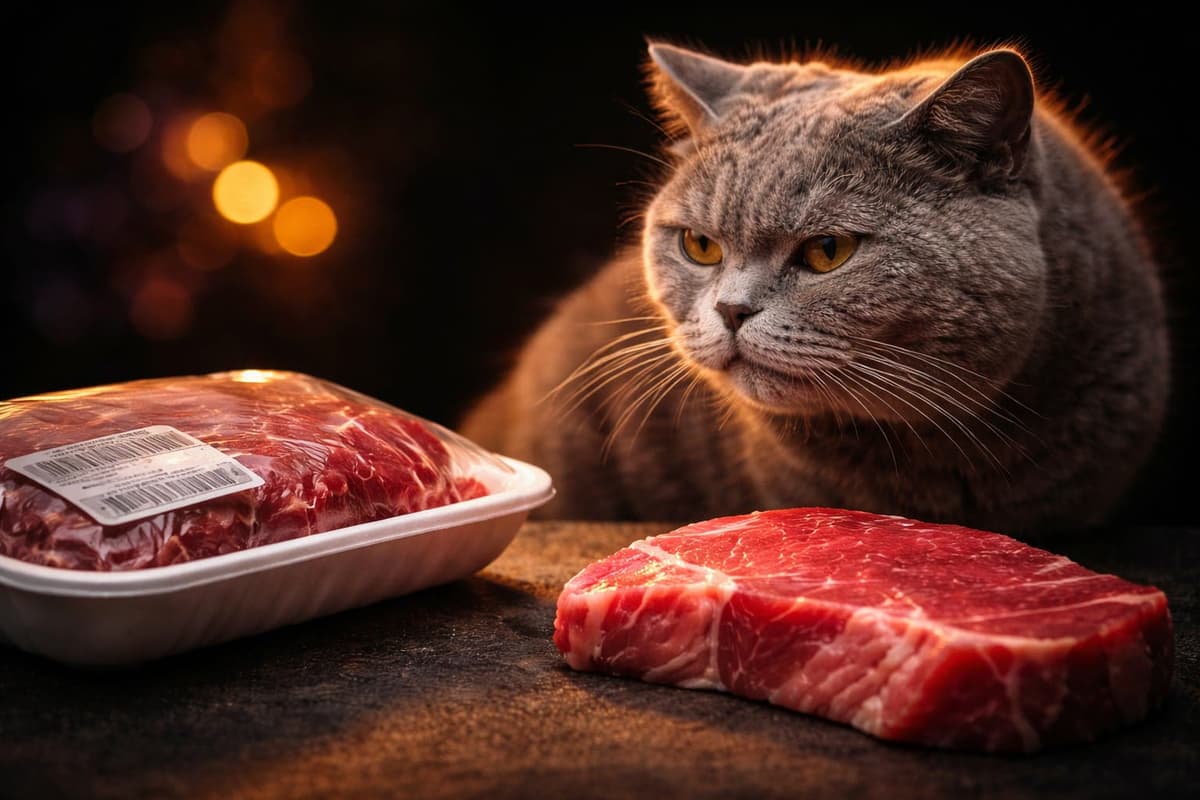
You buy a chicken at a discount store. Pink, neatly packaged, use-by date three days out. You put a piece in the cat's bowl. Your cat approaches, sniffs, gives you a reproachful look, and walks away. Didn't even lick it.
You buy meat at the market, from the butcher, straight off the counter. The cat lunges at the bowl before you can even set it down.
Spoiled? Fussy? No. Your cat has 200 million reasons to reject that supermarket meat. Literally — that's how many scent receptors it has. And every one of them is telling it something your nose can't detect.
The feline nose: 200 million receptors and an organ you don't have
Before we talk about meat — we have to understand the tool a cat uses to judge it.
Scent receptors
| Parameter | Cat | Human | Dog |
|---|---|---|---|
| Scent receptors | ~200 million | 5-6 million | 220-300 million |
| Olfactory epithelium | 20 cm² | 4 cm² | 170 cm² |
| V1R receptors | 30 variants | 2 variants | 9 variants |
200M
Forty times more than a human. Plus the Jacobson's organ in the palate — a second chemical laboratory in the head. Plus 30 variants of V1R — ultra-precise discriminatory filters.
A dog has more scent receptors overall and a larger epithelium — but a cat has over 3 times more V1R receptors than a dog and as much as 15 times more than a human. What are they? A special kind of discriminatory receptor that works like an ultra-precise chemical filter. They're responsible for distinguishing the finest nuances of smell.
They're not responsible for how far away an animal can detect a scent (tracking dogs are the masters there), but for absolute precision in analyzing that scent up close.
A dog smells farther. A cat smells more precisely. Where a dog smells simply "meat," a cat smells "meat, 4 days from slaughter, the early oxidation of linoleic acid, an elevated concentration of hexanal, trace amounts of putrescine." And makes a decision: no.
The Jacobson's organ
Cats have an additional sensory organ that humans lack — the vomeronasal organ, commonly called the Jacobson's organ. It sits in the palate, just behind the upper incisors.
When you see a cat with its mouth slightly open and a "strange face" (lifted upper lip, slightly narrowed eyes) — that's the flehmen response. The cat is sending chemical molecules from the air through its palate to the Jacobson's organ, which analyzes them independently of the nose. It's as if it had two separate chemical laboratories in its head — one in the nose, one in the mouth.
A study by Salazar et al. (2011) described the structure of the feline vomeronasal organ in detail. It's superbly developed and capable of analyzing both volatile and non-volatile chemical compounds.
Decision hierarchy: nose > mouth
Here we reach the key discovery. Researchers (Hullár et al., 2001) studied how cats choose food and established a clear hierarchy.
Cats undoubtedly use smell in the detection and selection of food. When odor significantly differs between options, cats consumed preferred food exclusively without tasting alternatives.
— Hullár, Fekete, Andrásofszky et al., 2001
In plain terms: a cat decides with its nose. If the smell of one food is clearly better than another — the cat eats ONLY the better one. It doesn't even try the worse one. Taste enters the game only when smell gives no clear-cut answer.
That explains why your cat didn't even lick that discount-store chicken. Its nose said "no" — so the mouth never got a chance to vote.
What happens to meat in the supermarket?
Fat oxidation — the invisible enemy
The most important process of meat degradation is lipid oxidation, colloquially — rancidity. It's a natural but destructive process in which oxygen from the air literally destroys the fat molecules in meat. It begins immediately after slaughter and accelerates with oxygen, light and temperature.
According to research (Domínguez et al., 2019) this process has three phases:
- Initiation phase: Free radicals form — extraordinarily aggressive, unstable molecules that attack healthy, unsaturated fatty acids. The radicals damage the fats, kicking off spoilage and the loss of nutritional value.
- Propagation phase (chain reaction): One radical attacks the next fatty acid. The avalanche of destruction grows exponentially.
- Termination phase: The damaged compounds break down into aldehydes (hexanal among them), ketones and alcohols. These volatile substances are responsible for the repellent smell of spoiled meat.
The key scent markers of oxidation are:
| Compound | Smell | Detection threshold (human) |
|---|---|---|
| Hexanal | Rancid fat, "old paint" | <38 ppb |
| Pentanal | Sharp, woody | <34 ppb |
| Heptanal | Greasy, rancid | 62 ppb |
These detection thresholds apply to the human nose with 5 million receptors. The feline nose (with 200 million receptors and specialized V1R filters) detects these aldehydes at concentrations tens to hundreds of times lower. Meat that smells "normal" to you simply reeks to a cat of rancid fat or old oil paint — and that's no joke: in sensory chemistry, hexanal smells exactly like oxidized linseed oil in old paints.
MAP packaging — a beautiful lie
Most meat in Polish supermarkets is packaged in the MAP system — Modified Atmosphere Packaging. The standard gas mix under the film is 70-80% oxygen and 20-30% carbon dioxide.
70-80% O₂
Why pack in so much oxygen? For the beautiful, artificially maintained, blood-red color of oxymyoglobin. That's enough for the shopper. Not for the feline nose.
This stems from the biology of myoglobin, the natural protein that gives meat its color. When you combine myoglobin with such a powerful dose of oxygen, it becomes oxymyoglobin — gaining that beautiful, blood-red color we so like to see on supermarket trays. Red meat = fresh meat. At least in the shopper's eyes.
The problem is that the same oxygen that maintains the nice color simultaneously dramatically accelerates fat oxidation.
Research (Lund et al., 2010) proved that meat in high-oxygen packaging shows:
- Accelerated fat oxidation → more aldehydes → a rapid smell of rancidity
- Protein polymerization — a process in which, under the influence of oxygen, the proteins in meat clump into large networks, making the meat tougher and changing its texture
- A characteristic "warmed-over" flavor (WOF), even if the meat was 100% raw
What's more, research on pork (Cornale et al., 2019) showed that after 7 days, meat from MAP packaging had significantly higher off-odors than vacuum-packed meat.
Vacuum looks worse, but is fresher
The irony is that vacuum-packed meat is visually darker, but biochemically far fresher. MAP meat looks beautiful, but chemically it's tired and spent. Your cat isn't looking at the color. It's smelling. And what it smells from a supermarket tray after a few days is unacceptable.
The three forms of myoglobin — what the feline nose "sees"
| Form | Color | Chemical state | What the cat smells |
|---|---|---|---|
| Deoxymyoglobin | Purplish-red | No contact with oxygen | Neutral — fresh, but "closed off" |
| Oxymyoglobin | Bright red | Fresh + lots of oxygen | OK at first, then aldehydes rise |
| Metmyoglobin | Brown | Oxidized — degradation | Altered scent profile — a "stale" signal |
For humans, the appearance of metmyoglobin (browning) is a visual signal that meat has sat too long. For a cat it's a chemical signal — browning is accompanied by changes in the profile of volatile compounds that the feline nose registers long before the color even changes.
Biogenic amines — the smell that says "DON'T EAT"
While meat sits on the shelf, bacteria don't sleep. They break proteins down into biogenic amines — chemical compounds with an extraordinarily intense putrid smell, an evolutionary warning signal: "carrion lies here."
The key amines that form in spoiling meat are:
- Cadaverine (from the Latin cadaver — corpse, the smell of a decomposing body)
- Putrescine (from the Latin putresco — to rot, a strong smell of decay)
- Histamine (an irritating smell)
- Tyramine (sharp, fishy)
Supermarket meat within its use-by date is deemed fully "acceptable" for humans. Yet amines like cadaverine and putrescine have such an overwhelming smell that a cat detects them at concentrations that remain entirely undetectable to the human nose. Your meat smells "normal." The feline nose says: "something here is rotting."
A double safety system: bitter taste blocks umami
Even if the smell doesn't deter the cat enough and it decides to try a piece, a second line of defense kicks in, located on the tongue.
A cat's bitter-taste receptors immediately detect the products of protein breakdown — those same cadaverines and putrescines. But the most interesting discovery comes from a study by McGrane et al. (2023). It turned out that bitter-tasting substances simultaneously and completely block the umami receptors — that is, the main receptors responsible for the taste of meat.
This is a brilliant, double evolutionary safeguard:
- Spoiled meat tastes bitter.
- Spoiled meat instantly stops tasting like meat.
If a mouse has lain in the sun for three hours, a cat needs to know not to eat it. The scent system says "careful," and the taste system shouts "spit it out." No compromises.
Cats vs. dogs: why are cats "fussier"?
The data from the pet-food industry is ruthless on this point. Companies producing palatants (substances — liver extracts, for instance — added artificially to foods to unnaturally boost their smell and palatability) know it perfectly well: dogs can tolerate moderate fat oxidation. Cats have zero tolerance for it. Why?
1. Ultra-filters V1R: a cat distinguishes incomparably subtler nuances of smell. "Slightly oxidized" and "fresh" are a vast chasm to it.
2. Strict carnivory: a cat eats ONLY meat. Eating carrion is a risk of certain death, so the evolutionary pressure to detect spoilage was extremely strong in cats. A dog is a natural opportunist (it'll eat almost anything), so the safety filters are weaker.
3. Decision hierarchy: a cat decides with its nose BEFORE tasting. A dog far more often applies the rule "I'll eat first and see later."
Temperature: 37°C = "freshly hunted"
There's one more important factor: temperature. Research conclusively shows that cats most readily eat food at a temperature of 37°C.
That's the body temperature of prey a predator has just hunted. In feline logic: warm = fresh = safe. Cold = long dead = dangerous.
What's more, warmer meat physically releases more volatile scent compounds (umami). Warming meat to room temperature often makes a cat that previously ignored it suddenly pounce on the bowl with enormous appetite.
Why is butcher's meat "better"?
Let's go back to the first paragraph. Why does a cat choose the butcher over the discount store?
| Factor | Supermarket (MAP) | Butcher / market |
|---|---|---|
| Time from slaughter | 3-7 days | Often 1-2 days |
| Packaging | HiOx-MAP (70-80% O₂) | Paper, vacuum or none |
| Oxidation | Accelerated by oxygen | Slower |
| Aldehydes (stench) | Higher concentration | Lower concentration |
| The feline nose's verdict | Rejected | Accepted |
Butcher's meat isn't magically "cleaner" microbiologically. It's simply biochemically fresher — it has fewer oxidized, rancid fats and a scent profile matching what the feline nose has, for millions of years, treated as fresh prey.
What does this mean for a BARF cat's owner?
-
The meat source matters enormously. Look for butchers, fresh deliveries, or vacuum-packed meat. Avoid beautiful, red MAP trays near the end of their use-by date.
-
Freezing is your best friend. Freezing meat quickly, straight after slaughter, fully halts oxidation.
-
Experiment with temperature. Add a little warm water to the bowl of raw food before serving.
-
Don't fight the feline nose. Those 200 million receptors evolved to protect your cat. If it stubbornly refuses to eat a given batch of meat — trust it.
The calculator can't replace freshness
The mrumi BARF calculator will flawlessly compute the ideal ratios of taurine, vitamins and macrominerals. But it's on you to source meat that will ultimately pass the rigorous quality test of the feline nose. Balance + freshness = a healthy cat.
The next time your cat rejects store-bought meat, don't call it fussy. Listen to it. After all, 200 million scent receptors simply can't be wrong.
Sources
- Hullár I., Fekete S., Andrásofszky E., Szöcs Z., Berkényi T. Factors influencing the food preference of cats. J Anim Physiol Anim Nutr. 2001; 85(7-8):205-211. PMID: 11686790.
- Domínguez R. et al. A Comprehensive Review on Lipid Oxidation in Meat and Meat Products. Antioxidants. 2019; 8(10):429. PMC 6827023.
- Lund M.N. et al. High-oxygen modified atmosphere packaging induces lipid and myoglobin oxidation and protein polymerization. Meat Science. 2010; 85(3):462-9. PMID: 20444557.
- Cornale P. et al. High Oxygen Modified Atmosphere Packaging Negatively Influences Consumer Acceptability Traits of Pork. Foods. 2019; 8(12):684. PMC 6915632.
- Ruiz-Capillas C., Herrero A.M. Impact of Biogenic Amines on Food Quality and Safety. Foods. 2019; 8(2):62. PMC 6406683.
- Lei W. et al. Functional Analyses of Bitter Taste Receptors in Domestic Cats (Felis catus). PLoS One. 2015; 10(10):e0139670. PMC 4619199.
- McGrane S.J. et al. Umami taste perception and preferences of the domestic cat (Felis catus), an obligate carnivore. Chemical Senses. 2023; 48:bjad026. PMC 10468298.
- Salazar I. et al. A detailed morphological study of the vomeronasal organ and the accessory olfactory bulb of cats. Microsc Res Tech. 2011; 74(6):567-78. PMID: 21484946.
- Drivers of Palatability for Cats and Dogs — What It Means for Pet Food Development. Animals. 2023; 13(7):1134. PMC 10093350.
- Verberne G., de Boer J. Chemocommunication among domestic cats, mediated by the olfactory and vomeronasal senses. Z Tierpsychol. 1976; 42(1):86-109. PMID: 1007653.
Frequently asked
Why does a cat choose meat from the butcher rather than the supermarket?
Because butcher's meat is biochemically fresher — it sits a shorter time after slaughter (1-2 days vs. 3-7), it's packed in paper or vacuum rather than MAP with 70-80% oxygen, it has fewer oxidized fats and a lower concentration of aldehydes. Your cat smells this, even if your nose can't.
Is MAP packaging dangerous for my cat?
Not so much dangerous as chemically tired. The 70-80% oxygen mix keeps the red color of myoglobin, but at the same time accelerates fat oxidation (more hexanal, pentanal) and protein polymerization. The meat looks fresh, but the feline nose detects rancidity.
What are biogenic amines and why does a cat fear them?
Biogenic amines (cadaverine, putrescine, histamine, tyramine) are compounds that form when bacteria break down the proteins in meat. A cat detects them at concentrations undetectable to humans — an evolutionary warning signal: carrion lies here. Meat still within its human use-by date may already carry amines in amounts a cat flags as rotting.
Does warming meat to 37°C improve acceptance?
Yes. 37°C is the body temperature of prey just after the kill. Warmer meat physically releases more volatile umami compounds, which a cat's receptors detect. Often a cat that ignores cold meat will pounce on the same meat lightly warmed.