You walk into the kitchen at night for a glass of water. You grope for the light switch, bump into a chair. And the cat? It's already on the counter, looking at you with mild pity, probably wondering why you're making so much noise. For it, that same room is not a black hole — it's a legible map of shadows and shapes.
For centuries people explained this with magic, a feline sixth sense, or glowing eyes that cast their own light. The truth is less mysterious and far more elegant: the cat's eye is a masterpiece of light engineering, refined over millions of years of hunting at dawn and dusk. But before we take the mechanism apart, we have to debunk a myth that has been around since antiquity.
Debunking the myth: cats do not see in total darkness
That sentence repeated everywhere — "cats see in the dark" — is simply a myth. Vision, feline and human, relies on the same thing: registering photons, the basic particles of light striking the retina. Where there is no light, there are no photons. And where there are no photons, there is nothing to register — no eye, however perfect, can conjure an image out of nothing.
In a space with no light source whatsoever — a sealed cellar, or a windowless room with the door taped shut — a cat is just as blind as we are. Its real superpower is something else: extremely efficient use of leftover light. Starlight through a window, a city's glow reflected off the clouds, a charger's LED, a sliver of light under the door — for a cat, that's more than enough. Where we already see only black, it still has a fully usable image.
A cat is an animal of the twilight, not the night
More accurate than "nocturnal animal" is the term animal of the twilight, technically called a crepuscular animal. Cats specialized in hunting at dawn and dusk — in that borderline hour when light is scarce but not zero, and their prey (mainly rodents) is most active.
The entire feline eye is optimized for exactly this lighting regime. It comes down to three brilliant solutions, which I describe below, relying solely on peer-reviewed research — that is, work rigorously checked before publication by independent scientists.
Compute your cat's diet — BARF calculatorOpen calculatorSolution 1: the tapetum lucidum — a mirror that gives light a second chance
If the cat's eye had one main trick that gives it an edge over the human eye, it would be the tapetum lucidum. This Latin name literally means "shining carpet" and refers to a thin, reflective layer located right behind the retina, in the choroid at the back of the eye.
The principle is disarmingly simple. In a human, a photon that slips between the photoreceptors (the light-sensitive cells) and isn't caught by them is lost for good — it soaks into the dark pigment layer at the back of the eye. In a cat, that same photon bounces off the reflective carpet and comes back, passing through the light-sensitive layer a second time. So the visual cell gets two chances to catch the same quantum of light. It's like reading a difficult text twice — on the second pass you catch what slipped by at first.
This biological reflector is remarkably effective. Scientific measurements have shown that this layer reflects most of the incoming light. Researchers Gunter, Harding, and Stiles measured its reflectance precisely as early as 1951, and Coles described these unique optical properties in 1971 in the "Journal of Physiology." The result is a huge boost in the eye's sensitivity in low light — without having to add any new visual cells.
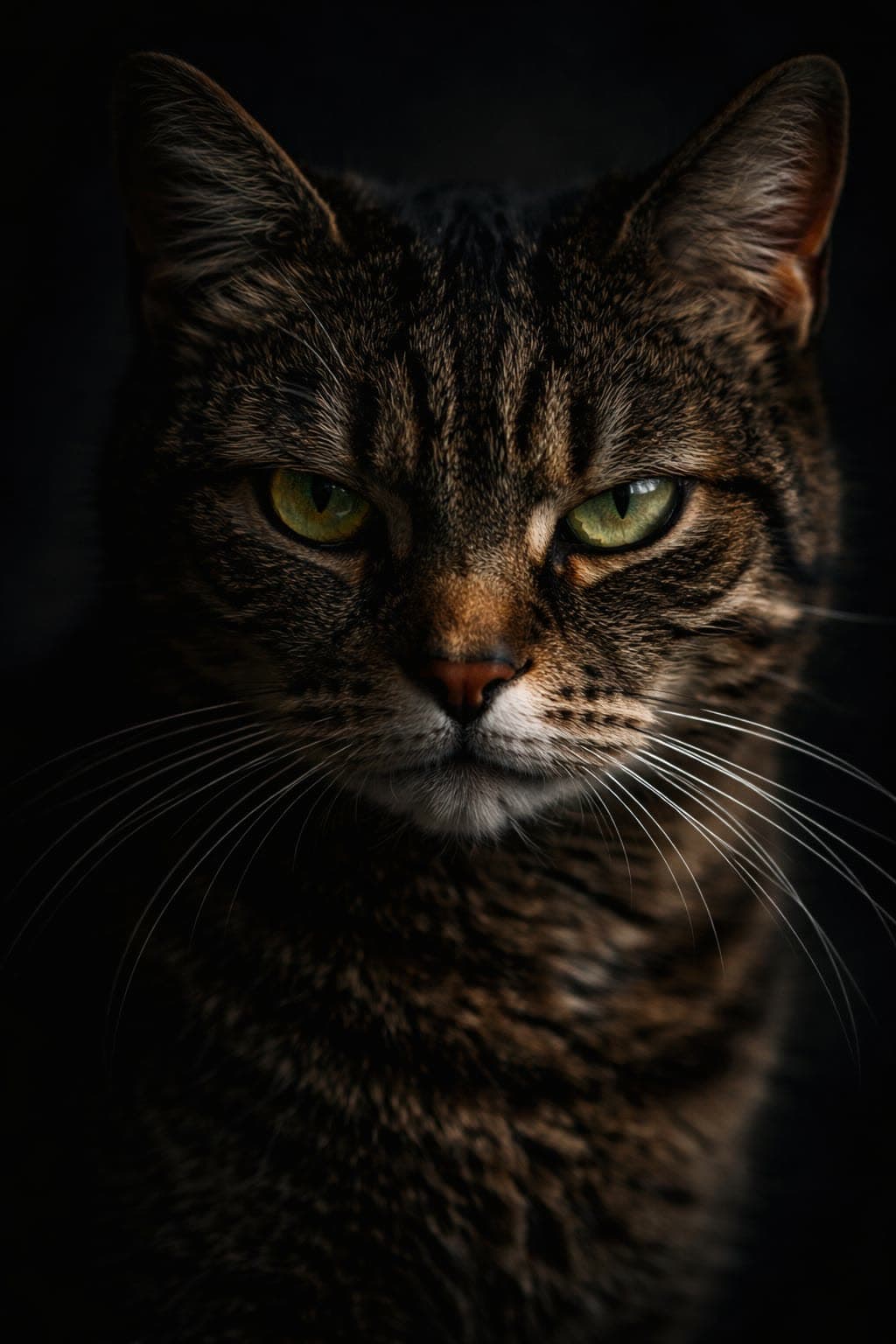
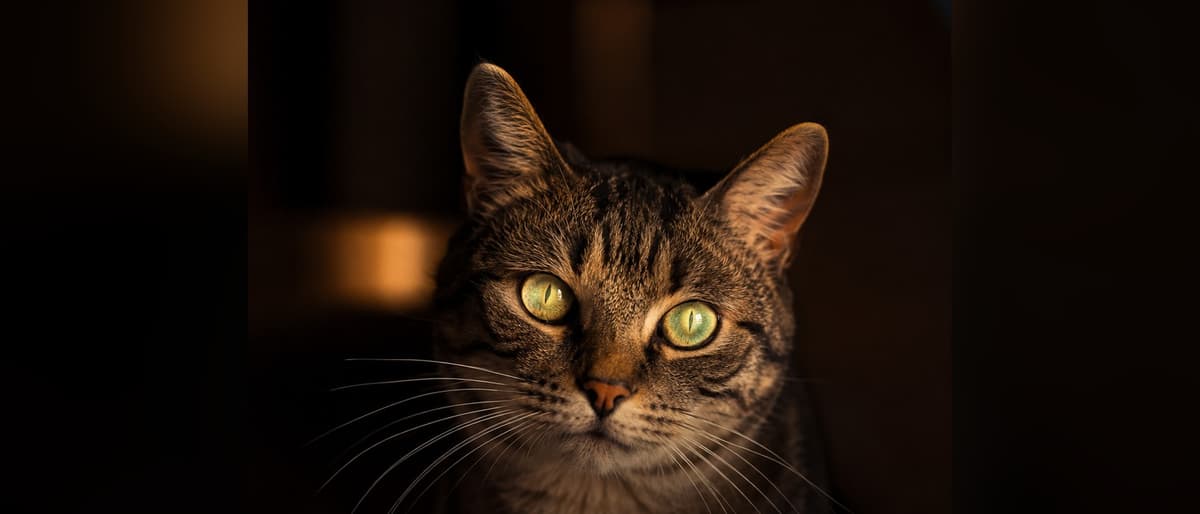
It's worth knowing that the distinctive yellow-green glow of a cat's eyes in the beam of a flashlight is nothing but light reflected off this internal mirror, returning to our eyes. Humans have no such structure — which is why photos give us the "red-eye" effect, a reflection off the blood vessels at the back of the eye rather than off a mirrored coating.
The exception: blue-eyed and white cats
In Siamese, Ragdoll, or Neva Masquerade cats — and in white cats carrying the dominant white gene — the reflective layer is often greatly reduced or absent entirely. As early as 1980, Thibos, Levick, and Morstyn found that the blue eye of a white cat usually lacks this structure. In such cats, a camera flash brings out not a green but a red reflection. It's most striking in odd-eyed cats: the amber eye glows green, the blue one red.
From a chemical standpoint, the microscopic crystals that build this feline mirror are rich in zinc bound to the amino acid cysteine, which stabilizes the whole structure. The characteristic yellow-green color comes from a very high concentration of riboflavin, vitamin B2 — researchers Elliott and Futterman isolated it from the cat's eye back in 1963. Structurally, in the cat this tissue is of the tapetum lucidum cellulosum type: a cellular structure in which high reflectance arises from precisely arranged layers of cells acting like a biological photonic crystal — a natural nanostructure that steers the flow of light.
Solution 2: a retina tuned for night
The mirror is only half the success. The other half is the retina itself — specifically, the ratio of two types of light-sensitive cells. The first are rods, detectors that work in low light. They are ultra-sensitive and register movement and contrast, but they can't distinguish colors and give a less sharp image. The second are cones, responsible for color and high resolution, but they need a lot of light to work.
This is an evolutionary trade-off built into every eye: you can have a daytime retina (lots of cones, a sharp and colorful image, but poor vision after dusk) or a night retina (lots of rods, excellent light sensitivity, at the cost of sharpness and color). Evolution placed the cat firmly on the side of the night.
~460,000
The classic anatomical study by Steinberg, Reid, and Lacy from 1973 counted the cells in the feline retina precisely. At its edges, a single cone is served by as many as dozens of rods — the eye is maximally packed with cells built to work after dark.
There's a second consequence of this design. Many individual rods feed into a single shared nerve cell that passes the signal on — in neurobiology we call this convergence. Thanks to it, impulses from extremely faint light sum together before reaching the brain. The cat's eye then works a bit like a camera with the ISO — the sensor's sensitivity to light — cranked way up. The price of this summing, however, shows up when it comes to sharpness.
Solution 3: the slit pupil, an aperture with an enormous range
The third key element is the pupil. In a cat it isn't round like ours, but vertical and slit-shaped. This is no aesthetic accident, but an important adaptive function.
The vertical slit has one huge advantage: an incredible range of adjustment. In full, harsh sun, a cat can narrow it to the thickness of a fine thread, almost completely cutting off the light and protecting its delicate night retina from being dazzled. At night it widens to a nearly full, round circle, letting in the maximum amount of available photons.
~135×
On top of this comes a relatively large cornea and lens for such a small head, working like a big, bright lens that gathers light from the surroundings. All three mechanisms — the reflective mirror, the rods, and the vertical pupil — play on the same team.
The price of night vision: sharpness and color
Nature never gives anything for free. For its mastery of the half-dark, the cat pays two serious bills that are easy to notice in everyday life.
First — image sharpness. The small number of cones and the strong summing of signals from rods mean the cat's image is noticeably less detailed than ours. A cat's visual acuity is estimated at roughly 20/100 to 20/200 on the Snellen scale (the traditional eye-test scale). Converted to meters, this means that details we see sharply from 30 meters, a cat only makes out clearly from about 6–9 meters away.
Research on spatial vision that Pasternak and Merigan published in 1981 in "Vision Research" showed something reassuring, though: the difference in sharpness between cat and human shrinks sharply as the light drops. On a bright day we see the world far more sharply, but as dusk falls our advantage melts away — and then reverses entirely in the cat's favor.
Second — color. Since the cells responsible for color are few, the whole palette suffers. A cat is most likely a dichromat — its retina has only two types of cones instead of our three. It distinguishes shades of blue and yellow-green well, while red is poorly visible to it and gets confused with gray or green, much as in a human with protanopia (a congenital deficiency in seeing red).
A cat doesn't see better than we do. It simply sees differently — evolutionarily, it bought nighttime ability and paid for it with the quality of daytime vision.
A cat's world, then, is not black and white — it's simply very pastel, resembling a slightly faded photograph.
What this means for you and your cat
This sophisticated anatomy has very real implications for your daily life together.
Don't leave your cat at night in a completely dark room, thinking it can see everything anyway. A cat needs at least a minimal amount of light. A gentle night light is more than enough and will help it move around — which matters especially for senior cats.
When a cat's vision needs a vet
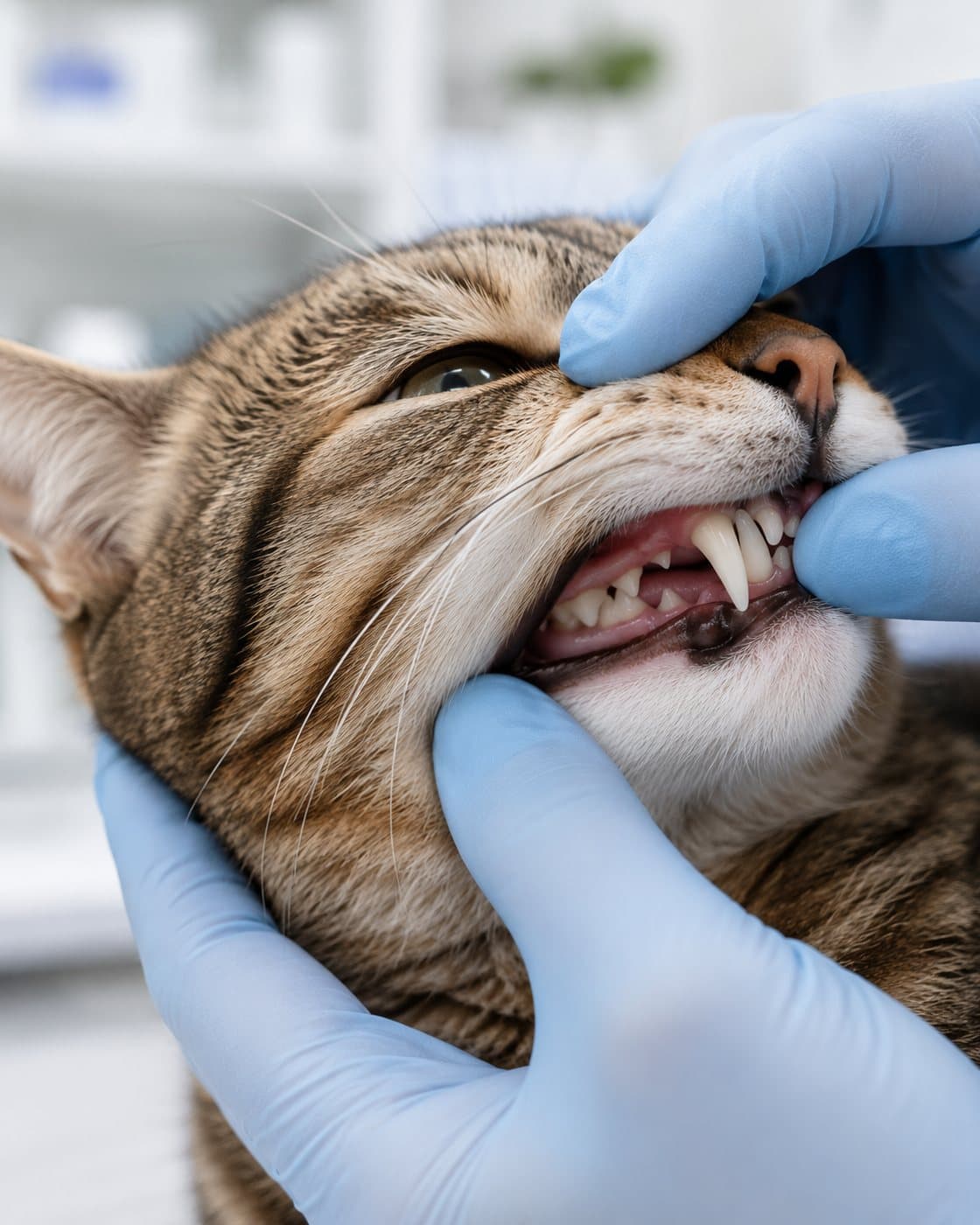
With age, the retina's sensitivity naturally declines, and certain insidious diseases — arterial hypertension, diabetes, or retinal degeneration (for instance, caused by a taurine deficiency in the diet) — can silently damage vision. If you notice your cat starting to bump into furniture, keeping its pupils permanently wide and fixed, or coping noticeably worse after dark, that's a sign to see a vet promptly. Some of these causes are fully reversible if treatment is started early enough.
Don't rearrange its home world abruptly. A cat navigates space partly through an excellent topographic memory and through its whiskers (vibrissae), which perfectly complement vision at close range. A fixed, unchanging spot for the litter box, bowls, and main furniture gives a cat an enormous sense of security.
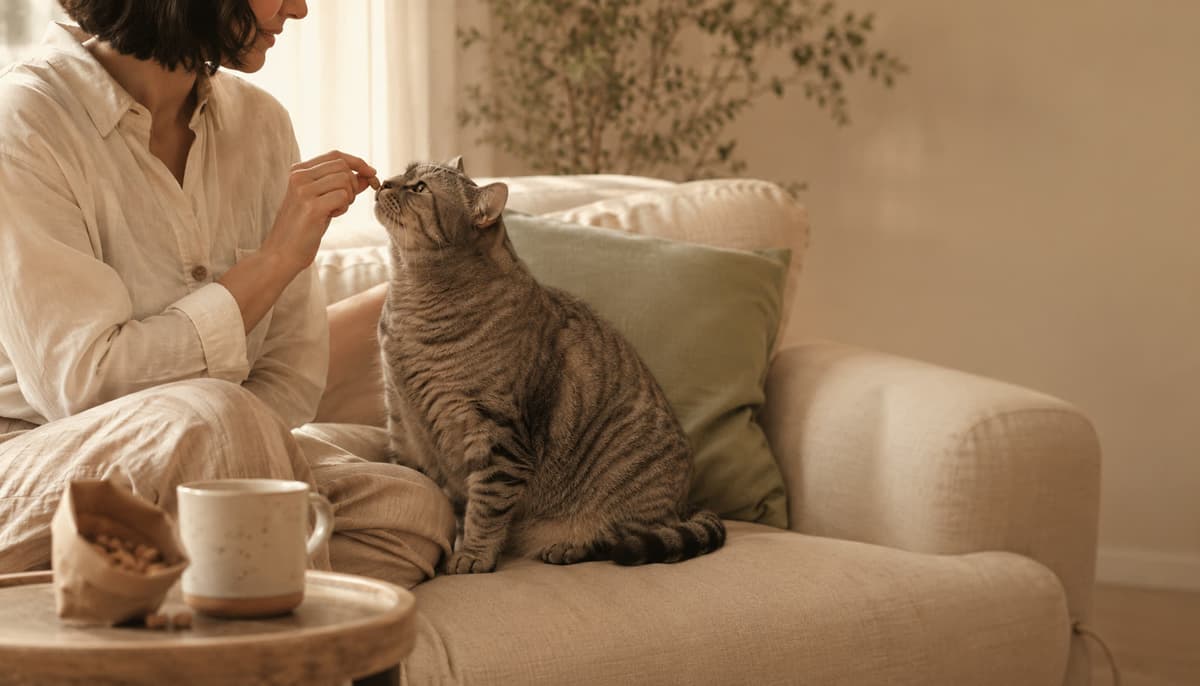
Remember that right under its own nose, a cat sees very poorly. An eye tuned for distance and half-light has real trouble focusing on objects closer than 25–30 centimeters. That's exactly why a cat often "loses" a treat offered right under its muzzle and has to find it by smell and the touch of its whiskers. This is completely normal — not a defect of vision.
In summary: not magic, just optics
For centuries, cats' eyes glowing in the dark stirred superstitious fear in people. Today science proves there's nothing supernatural about them. It's simply a perfect, three-stage trick with light: a reflective mirror that sends escaping photons back, a dense retina studded with rods, and a vertical pupil that opens to the night like the aperture of a professional camera. Together they give the cat a clear image where a human sees only impenetrable black.
References
- Steinberg R.H., Reid M., Lacy P.E. (1973). The distribution of rods and cones in the retina of the cat (Felis domesticus), Journal of Comparative Neurology 148(2):229-248doi:10.1002/cne.901480209
- Gunter R., Harding H.G.W., Stiles W.S. (1951). Spectral reflexion factor of the cat's tapetum, Nature 168:293-294doi:10.1038/168293a0
- Coles J.A. (1971). Some reflective properties of the tapetum lucidum of the cat's eye, Journal of Physiology 212(2):393-409doi:10.1113/jphysiol.1971.sp009331
- Elliott J.H., Futterman S. (1963). Fluorescence in the tapetum of the cat's eye, Archives of Ophthalmology 70:531-534doi:10.1001/archopht.1963.00960050533017
- Ollivier F.J. i wsp. (2004). Comparative morphology of the tapetum lucidum (among selected species), Veterinary Ophthalmology 7(1):11-22doi:10.1111/j.1463-5224.2004.00318.x
- Pasternak T., Merigan W.H. (1981). The luminance dependence of spatial vision in the cat, Vision Research 21:1323-1330
- Thibos L.N., Levick W.R., Morstyn R. (1980). Ocular pigmentation in white and Siamese cats, Investigative Ophthalmology & Visual Science 19(5):475-486
Frequently asked
Do cats really see in total darkness?
No. Vision works by registering photons — particles of light striking the retina. Where there is no light source at all (a sealed cellar, a windowless room with the door taped shut), there are no photons, so a cat is just as blind as a human. What a cat is brilliant at is using even the tiny amounts of light we no longer notice.
Why do cats' eyes glow in the dark?
It's light reflected off the tapetum lucidum — a reflective layer right behind the retina that bounces photons back and gives the visual cells a second chance to catch them. That distinctive yellow-green glow is simply this reflected light returning to our eyes. Humans have no such layer, which is why photos give us the „red-eye” effect instead.
Does my cat see colors?
Yes, but differently from us. A cat is most likely a dichromat — its retina has two types of cones instead of our three. It distinguishes shades of blue and yellow-green well, but confuses red with gray or green. Its world isn't black and white; it's pastel, like a slightly faded photograph.
Should I leave a light on for my cat at night?
A cat doesn't need bright light, but total darkness doesn't serve it well — especially senior cats. A gentle night light (a small plug-in unit, for example) is more than enough and helps it move around safely.