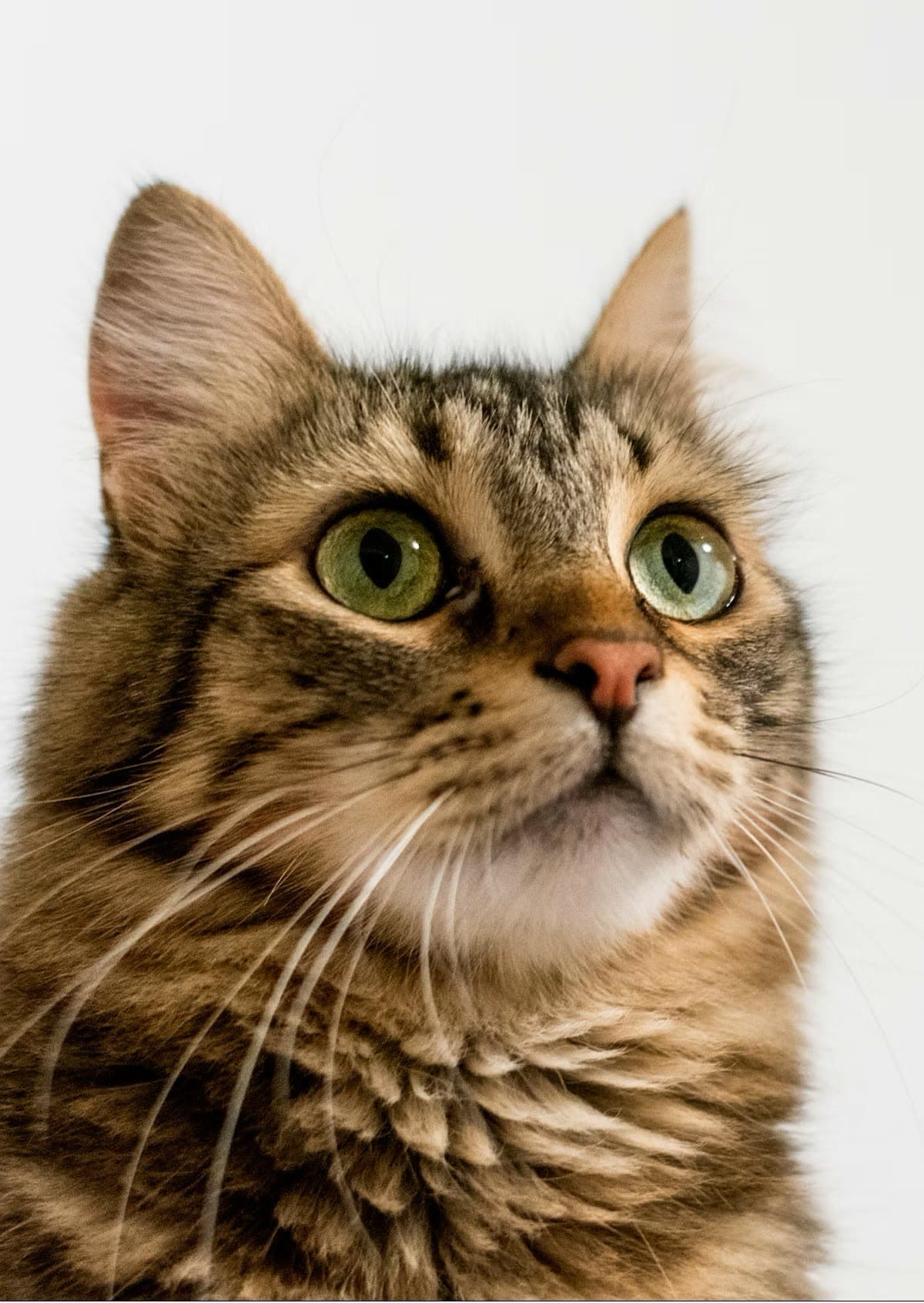
Look at your cat right now.
Is it asleep? If so — which side is it lying on?
It sounds trivial, but in June 2025 a group of neuroscientists from Germany, Italy and Turkey announced in the prestigious journal Current Biology that the position a cat lies in while sleeping is not random. According to their analysis of 408 YouTube videos, two-thirds of cats choose the left side.
The media headlines: „Cats have an evolutionary early-warning system switched on even while they sleep." Within weeks the story circled the globe — from the BBC to local news sites.
Except that eight months later, another team published a replication. And… found no preference at all.
What's going on? And what does it all mean for you and your cat?
Spoiler: the neurobiological mechanism behind the hypothesis is solid. It's just that a single YouTube-based study is shaky evidence. Along the way you'll meet the fascinating world of the cat brain's asymmetry — and the surprising fact that your cat listens to you with its right ear, but swings its left ear round when a dog barks outside.
1. The famous YouTube study — Isparta et al. 2025
Let's start with what kicked off the storm.
How did the study work?
In June 2025, a team led by Sevim Isparta (Turkey), with Sebastian Ocklenburg and Onur Güntürkün (Germany) — leading authorities on brain lateralisation (the division of roles between the right and left hemispheres) — published a three-page scientific report (a Correspondence) in Current Biology. It's a short scientific format, not a full empirical article — a difference that turns out to be crucial.
The researchers gathered 408 publicly available YouTube videos in which a cat:
- slept lying on its side for at least 10 seconds,
- was alone in the frame,
- was fully visible, from head to hind paws,
- appeared in the original footage (the material couldn't be mirrored or otherwise modified).
They coded each video as „left side" or „right side". And counted.
The result
| Sleeping position | Number of cats | Percentage |
|---|---|---|
| Left side | 266 | 65.1% |
| Right side | 142 | 34.8% |
Statistical test: chi-square χ² = 37.7; p < 0.001. In other words, the deviation from a random 50:50 split is „statistically significant" and unlikely to be down to chance.
The authors' hypothesis
Why the left side? The argument runs as follows:
„Sleep is one of the most vulnerable states for an animal, because alertness to predators is drastically reduced. Domestic cats are both predators and prey (for coyotes, for example) and sleep an average of 12–16 hours a day. They therefore spend nearly 60–65% of their lives in a state of high vulnerability."
Hypothesis: a lateralised sleeping position increases the chance of quickly detecting a threat just after waking.
The mechanism: at the moment of waking, a cat lying on its left side has its left visual field open upward. And the left visual field feeds signals to the right hemisphere — the one that specialises in detecting threats.
And that's where the fascinating neurobiology begins.
2. The right hemisphere = threat detector (the mechanism is solid)
Whether or not a preference for sleeping on a given side exists, the neurobiological mechanism behind the hypothesis is well documented. This isn't internet guesswork. It's fundamental knowledge about how the mammalian brain works.
Hemispheric asymmetry: animals react faster to a threat on the left
Vallortigara and Rogers (2020, Cortex) — a literature review spanning decades of research — show that in most vertebrate species:
- information from the left visual field goes to the right hemisphere,
- the right hemisphere is responsible for processing threats, maintaining vigilance and negative emotions,
- animals react faster to a predator approaching from their left.
This isn't feline eccentricity — it's the evolutionary heritage of all vertebrates. It holds in birds, fish, dogs, horses, humans and, of course, cats.
Rogers's classic experiment — the advantage of a lateralised brain
Rogers, Zucca and Vallortigara (2004, Proceedings of the Royal Society B) ran an ingenious experiment: they compared lateralised chicks (exposed to light while still in the egg, which activates brain asymmetry) with non-lateralised ones (incubated in the dark).
The task was to look for grain scattered among pebbles while simultaneously monitoring a model hawk hanging overhead.
Results:
- The lateralised chicks did splendidly — they searched for grain with the left hemisphere (categorisation) while monitoring the predator with the right hemisphere (vigilance). They did both at once, and efficiently.
- The non-lateralised chicks confused grain with pebbles and panicked at the sight of the hawk. Their brains simply couldn't handle two complex processes at the same time.
Conclusion: dividing roles in the brain confers a huge functional advantage — it lets the hemispheres specialise and do two things at once.
The right hemisphere in cats — independent evidence
The argument about the right hemisphere's role in threat processing in cats specifically has two very solid sources.
Siniscalchi, Laddago and Quaranta (2016, Laterality) studied 16 Burmese cats. They played them six different recordings: feline vocalisations (meowing, purring, growling) and dog sounds (signals of distress, isolation, play).
Results:
- To their own vocalisations (a meow, a purr), the cats reacted by turning their head and pointing the right ear toward the sound (activating the left hemisphere, responsible for social communication).
- To dog signals heralding a threat, the cats turned the left ear toward the sound (activating the right hemisphere, linked to vigilance and fear).
As the authors put it: „Highlighting the role of the left hemisphere in intraspecific communication and the right hemisphere in processing threatening and alarming stimuli."
Mazzotti and Boere (2009, Laterality) added a biomarker: cortisol (the stress hormone) in cats correlates with a raised temperature in the right ear — because increased blood flow in the right hemisphere simply generates heat. It's not a metaphor. The right-hemisphere activity of an anxious cat can literally be measured with a thermometer.
What does it mean?
Isparta's 2025 hypothesis of „the left side as sentinel mode" has strong neurobiological foundations. The mechanism itself exists and is documented across many species, cats included. The only question is: do cats actually use it while they sleep?
And that's where the scientific problem begins.
3. The replication that wasn't — Cooke 2026 and McDowell 2018
In February 2026, barely eight months after Isparta's publication, Andrew S. Cooke of the University of Lincoln published in the journal Laterality an article with a telling title: „No evidence for lateralized bias or preference in the sleeping positions of domestic cats".
What did Cooke do?
He ran three independent analyses:
- YouTube videos (as in Isparta's study) — but featuring unique cats, avoiding repeats of the same animal.
- Photos from Reddit — giving a picture of a very broad population.
- Repeated photos of the same cats from Instagram.
Results:
| Source | Test | p-value |
|---|---|---|
| YouTube videos (unique cats) | χ² = 0.074 | p = 0.786 |
| Reddit images (unique cats) | χ² = 0.522 | p = 0.470 |
| Instagram (repeated images) | t = 0.836 | p = 0.407 |
None of the analyses showed a preference for the left side. The results were evenly split, 50:50.
Cooke's conclusion was blunt:
„Taking the full range of available evidence into account, it cannot be stated that there is any population-level preference, lateralisation or bias in the sleeping position of domestic cats. Contrary results may be explained by methodological problems."
An earlier voice: McDowell 2018
Seven years before Isparta's study, a team from Queen's University Belfast made an important discovery. McDowell, Wells and Hepper (2018, Animal Behaviour) studied 44 cats, making 50 observations of each of four behaviours per animal — a grand total of an impressive 2,200 observations.
Among other things, they examined choice of resting side.
Results for resting side:
- Only 25% of cats showed a preference for one particular side.
- A full 75% were ambilateral (no clear preference).
- Just 9.1% favoured the left side, and 15.9% the right.
The researchers summed it up: „Spontaneous lying-side behaviour, the only measure that did not focus on paw use, was NOT found to be lateralised."
Note the quality of the data: McDowell — 44 cats × 50 observations = 2,200 observations. Isparta — 408 cats × one observation each. Statistically, the McDowell study gives a far more accurate picture of an individual cat's behaviour.
The YouTube methodology problem: selection bias
Cooke and other critics point to a detail the Isparta team overlooked: systematic selection bias on YouTube.
Animal channels are full of „photogenic" shots. The person filming usually holds the phone in their right hand and stands to the animal's right (because about 90% of people are right-handed). A cat lying on its left side inevitably exposes its belly toward the lens — and such shots strike us as „cuter", so we're more likely to post them. The statistical advantage of left-side footage may simply come from that.
So what follows?
The neurobiological hypothesis itself is fascinating and strong, but pinning it on a single YouTube-video study turned out to be a misfire. The debate in the field is still ongoing, but the dominant scientific voice right now is sceptical: cats as a population probably don't show a clear preference for which side they sleep on.
That doesn't change the key fact, though: your cat's brain is asymmetrical. It just shows up in other situations.
4. What we really know about lateralisation in cats
Maybe the left side for sleeping is a scientific myth. But the lateralisation of the cat's brain is no myth — it's a hard, well-documented fact.
Paws: 78% of cats have a „left" or „right" paw
Ocklenburg, Isparta et al. (2019, Laterality) — a meta-analysis (a large pooled study summarising dozens of others) — shows that:
- as many as 78% of cats prefer to use a particular paw (to reach for food, catch toys, manipulate objects),
- unlike humans (90% right-handed), cats show no overall dominance of one side,
- there is, however, a very interesting sex effect: females are more often right-pawed, while males tend toward left-pawedness.
This sex split has been confirmed independently (Tan 1990, McDowell 2018, Wells & McDowell 2019, among others). The fact that it holds even in neutered cats suggests the asymmetry is permanently written into the structure of the brain, not merely a product of current hormone levels.
Breed matters — Bengals are exceptionally left-pawed
Wells and McDowell (2019, Animals) studied 56 pedigree cats and found that:
- Bengals show an extremely strong left-paw dominance (83.3% are lefties),
- Persians most often show no preference at all (they're ambilateral),
- breeds such as the Maine Coon, Ragdoll and Birman fall in the middle.
Interestingly, the stronger the brain asymmetry in a given breed, the greater its emotional reactivity. Bengals are famously lively and emotional, while Persians are renowned for their calm.
Lateralisation and temperament — the most practical finding
A study by McDowell, Wells, Hepper and Dempster (2016, Journal of Comparative Psychology) on 90 cats (30 left-pawed, 30 right-pawed and 30 ambilateral) yielded very valuable conclusions:
- Cats with a strong preference for one paw (whether left or right) are usually more confident, affectionate, friendly and biddable.
- Ambilateral cats show higher tendencies toward aggression, are less inclined to affection and harder to work with.
The authors' summary:
„Motor lateralisation in the cat is strongly associated with temperament, and the presence or absence of lateralisation matters more for emotional expression in this species than the DIRECTION of lateralisation."
In short: for a cat's mood, what matters is that it has a preferred paw at all — not which one it uses.
5. What does it mean for you and your cat?
How do you translate this neurological knowledge into everyday life?
Check your cat's dominant paw
You can run a simple test at home:
- Put an aromatic treat in a narrow container (e.g. a mug or jar).
- Wait for the cat to try to fish it out with its paw.
- Repeat the test at least 50 times over the course of a week — single attempts don't give a reliable result.
- Count: how many times the cat used the left paw, how many the right, and how many times it alternated.
Conclusions: if the cat consistently uses one paw in more than 70% of attempts, you've got a confident tough guy at home. If the result hovers around 50:50, be aware that your cat may be a little more prone to environmental stress.
Watch your cat's ears
How the ears react to stimuli says more about a cat than the position it happens to sleep in:
- The right ear turned toward a stimulus = positive processing (usually friendly cats or beloved owners).
- The left ear turned toward a stimulus = alarm, threat analysis, fear.
If your cat regularly turns its left ear toward a specific, recurring sound (a running vacuum cleaner, a baby crying, a neighbour's dog barking), its brain is analysing that stimulus as a real threat. It's worth working on softening that stressor.
A safe place to sleep — an absolute priority
Although the scientific battle over „the left side" is still raging, one thing is beyond doubt: evolution programmed cats to choose elevated, safe places to rest.
If your cat most often sleeps on the floor under an armchair, consider a more attractive alternative:
- a wall-mounted sleeping shelf,
- a tall scratching post with a sheltered platform,
- a bed on a high windowsill.
For a cat, resting up high isn't a whim — it's a need for safety coded deep into the brain.
Stress and lateralisation — an important caveat
So far, no peer-reviewed evidence has been published that changing sleeping side is a sign of stress. There are, however, indications that strong, chronic stress can make a cat lose its dominant paw and rely more on both (become ambilateral).
So: a sudden change in the side your cat falls asleep on is most likely a matter of comfort. But if a cat suddenly and clearly loses coordination or „forgets" which paw it used to fish toys out with — that may be a subtle warning sign for a behaviourist.
6. Lateralisation, attachment and the secure base — a little scientific speculation
I'll leave you with a thought straddling two entirely separate studies. It's fascinating speculation that hasn't (yet!) been formally tested — treat it as an open question, not a scientific fact.
Vitale, Behnke and Udell (2019, Current Biology) showed that 65.8% of cats form a secure, strong attachment style with a human — exactly the same proportion seen in human infants toward their parents. A cat with a secure bond treats its owner as a „secure base".
And here comes a deeply intriguing question: does a cat with a secure attachment sleep differently from one that doesn't feel supported by its owner?
If the Isparta team were even a little bit right about their „left-side sentinel mode", it would be logical to assume that a cat with a secure bond — sleeping close to its „base", i.e. you — simply doesn't feel the need to constantly scan its surroundings. It could fully relax in completely random positions, while a stressed cat would sleep differently.
No one has checked this yet. Who knows — maybe it's a topic for the next study?
Summary: what you need to remember
- The asymmetry of the cat brain is a fact. As many as 78% of cats prefer a particular paw, and ear reactions to stimuli are lateralised depending on threat. A cat's stress level can literally be measured by the temperature of its right ear.
- Sleeping on the left side is scientifically very doubtful. Cooke's replication (2026) and the large observational study by McDowell (over 2,200 observations, 2018) reject the claim that cats mostly sleep on one side.
- A feline early-warning system does exist. The right hemisphere of the mammalian brain really is responsible for analysing fear and predators — that's solid knowledge, even if cats don't happen to use it during a nap.
- Emotions depend on the paw. What matters is whether your cat has a favourite paw: ambilateral cats cope worse with stress, while lateralised cats are more often friendly and even-tempered.
- The environment makes a difference. Cats need safe, ideally elevated spaces to rest.
So the next time you look at a cat curled into a ball and sleeping on its left side, you don't need to worry that it's plotting an escape route. In all likelihood it has simply found the comfiest position.
But be sure of one thing: a cat's head hides an astonishing, far-from-symmetrical marvel of nature. The better you understand it, the stronger the bond you'll build with your four-legged predator.
References
- Isparta, S., Ocklenburg, S., Siniscalchi, M. et al. (2025). Lateralized sleeping positions in domestic cats, Current Biology, 35(12), R597-R598doi:10.1016/j.cub.2025.04.043
- Cooke, A.S. (2026). No evidence for lateralized bias or preference in the sleeping positions of domestic cats, Laterality (Online)doi:10.1080/1357650X.2026.2633997
- McDowell, L.J., Wells, D.L. & Hepper, P.G. (2018). Lateralization of spontaneous behaviours in the domestic cat, Felis silvestris, Animal Behaviour, 135, 37-43
- Ocklenburg, S., Isparta, S., Peterburs, J. & Papadatou-Pastou, M. (2019). Paw preferences in cats and dogs: Meta-analysis, Laterality, 24(6), 647-677↗
- Wells, D.L. & McDowell, L.J. (2019). Laterality as a tool for assessing breed differences in emotional reactivity in the domestic cat, Animals, 9(9), 647
- McDowell, L.J., Wells, D.L., Hepper, P.G. & Dempster, M. (2016). Lateral bias and temperament in the domestic cat, Journal of Comparative Psychology, 130(4), 313-320
- Siniscalchi, M., Laddago, S. & Quaranta, A. (2016). Auditory lateralization of conspecific and heterospecific vocalizations in cats, Laterality, 21(3), 215-227
- Mazzotti, G.A. & Boere, V. (2009). The right ear but not the left ear temperature is related to stress-induced cortisolaemia in the domestic cat, Laterality, 14(2), 196-204
- Vallortigara, G. & Rogers, L.J. (2020). A function for the bicameral mind, Cortex, 124, 274-285
- Rogers, L.J., Zucca, P. & Vallortigara, G. (2004). Advantages of having a lateralized brain, Proceedings of the Royal Society B, 271(Suppl 6), S420-S422
- Güntürkün, O., Ströckens, F. & Ocklenburg, S. (2020). Brain lateralization: A comparative perspective, Physiological Reviews, 100(3), 1019-1063
- Rogers, L.J. (2023). Knowledge of lateralized brain function can contribute to animal welfare, Frontiers in Veterinary Science, 10, 1242906
- Vitale, K.R., Behnke, A.C. & Udell, M.A.R. (2019). Attachment bonds between domestic cats and humans, Current Biology, 29(18), R864-R865doi:10.1016/j.cub.2019.08.036
- Tan, U., Yaprak, M. & Kutlu, N. (1990). Paw preference in cats: Distribution and sex differences, International Journal of Neuroscience, 50(3-4), 195-208
- Bálint, A., Reicher, V., Csibra, B. et al. (2024). Noninvasive EEG measurement of sleep in the family cat and comparison with the dog, Journal of Mammalogy, 105(2), 300-311
- Normand, C., Urbanek, R.E. & Hicks, C.L. (2021). Determining daytime resting site habitats of exurban feral cats, Urban Ecosystems, 24(4), 715-724
Frequently asked
Is it true that cats sleep on their left side?
It's very doubtful. The claim came from a single study (Isparta et al. 2025) based on 408 YouTube videos — and the „evolutionary early-warning mode” story went around the world. But just eight months later Cooke's replication (2026), across three independent analyses (YouTube, Reddit, Instagram), found no preference at all, and an earlier, far more precise study (McDowell et al. 2018, 2,200 observations) showed that 75% of cats have no preferred resting side. The prevailing scientific view today is sceptical: cats as a population probably don't pick a particular side to sleep on.
Does the side my cat sleeps on tell me anything about its stress?
There's no peer-reviewed evidence for that. A sudden change of sleeping side is most likely just the cat finding a comfier position. There are, however, indications that chronic stress can shift PAW preference toward ambilaterality. So rather than the sleeping side, watch whether your cat suddenly „loses” its dominant paw or loses coordination — that's a subtler signal worth raising with a behaviourist.
How do I find out which paw my cat prefers?
Put an aromatic treat in a narrow container (a mug or jar) and watch which paw the cat uses to fish it out. Repeat the test at least 50 times over a week — single attempts aren't reliable — and count left, right and alternating tries. A strong preference (>70% for one paw) usually goes with a confident, even temperament; a result near 50:50 means a cat that's a little more prone to stress.
What does it mean when my cat turns its left ear toward a sound?
That its brain is analysing the sound as a potential threat. Input from the left ear goes to the right hemisphere — the one handling vigilance and fear (Siniscalchi et al. 2016). Cats tend to respond to friendly, familiar sounds with the right ear (left hemisphere, social communication). If your cat regularly turns its left ear toward a specific, recurring sound (vacuum cleaner, a baby crying, a neighbour's dog barking), it's worth working on softening that stressor.