Your cat purrs, rubs against your legs, and then suddenly bites your hand? Lies on its back with its belly exposed, but when you stroke it — it catches you with its claws? Relax, this isn't malice. It's communication. The trouble is that most owners try to read a cat like a dog — and these are two completely different languages.
Time to learn the right one.
Why is it worth understanding a cat's body language?
Cats are masters of nonverbal communication. Unlike dogs, which were bred to cooperate with humans and make intensive use of their voice, cats spent thousands of years of evolution relying above all on body language. Meowing? That's largely an invention reserved for humans — adult cats almost never meow at one another. Among themselves they communicate through subtle signals: ear position, tail movement, pupil size, the set of the whiskers.
Understanding these signals isn't an academic curiosity — it's the foundation of a good relationship with a cat. When you can read that your cat is stressed before it starts hissing or running away, you can respond appropriately. When you recognize the signs of trust, you know the bond is deepening.
Ethological research confirms it: owners who can read their cats' body language experience behavioral problems less often. Their cats are calmer, less prone to aggression and more trusting. Why? Because they feel understood.
The tail — an emotional barometer
If you could observe only one part of a cat's body, choose the tail. It's the clearest indicator of your cat's emotions, a kind of emotional antenna constantly broadcasting signals.
- Tail held straight up — the feline equivalent of a smile. A cat that approaches you with its tail standing vertically upright is saying: "Hey, I'm glad to see you! I feel confident and safe." A slightly hooked tip is a bonus — an especially joyful greeting.
- Bristled tail (bottlebrush) — every hair stands on end, the tail looks like a bottle brush. The cat is trying to look bigger than it is. This is a signal of fear or defensive aggression. Don't touch — give it space.
- Tail tucked under the body — the cat feels threatened, submissive or very anxious. This is a stress signal that warrants attention. Check what in the surroundings is causing the discomfort.
- Slow, fluid swishing of the tail — the cat is focused and interested. It's watching a bird, tracking a toy, planning a pounce. Hunter mode — lovely to observe, but don't interrupt.
- Sharp thumping of the tail against the floor — careful, this is NOT wagging like a dog! In a cat it means irritation and mounting frustration. If you're petting the cat and you see this signal — stop immediately. A moment more and you'll get a claw.
- Tail wrapped around you — the feline equivalent of a hug. A gesture of deep trust.
Vigorous tail swishing ≠ joy
In a dog, wagging the tail is enthusiasm. In a cat — it's the last warning before an attack. If you're caressing a cat and its tail begins thumping sharply against the floor or your thigh, you may have two seconds before you get a claw. Withdraw your hand.
The ears — a radar of moods
A cat's ears are remarkable tools. Each ear can rotate independently through 180 degrees, controlled by over 30 muscles. Beyond their excellent hearing, the ears play a key communicative role.
30+
Each cat ear is controlled by over thirty muscles and rotates independently through 180 degrees. It's a radar of emotions whose position often precedes all other signals.
- Ears pointed forward — the cat is curious, relaxed and engaged. This is the "neutral" position of a healthy, happy cat.
- Ears flattened against the head — so-called "airplane ears." One of the most important warning signals: the cat is frightened, angry or defensive. Flattened ears protect them from damage in a possible fight. Back off.
- Ears turned to the sides — the cat is uncertain and on alert. It's trying to listen for sounds from different directions. A signal of discomfort that may escalate toward fear.
- One ear forward, the other back — the cat is internally conflicted. Something interests it, but at the same time worries it. Your cat is "processing information."
The eyes — a window to the soul
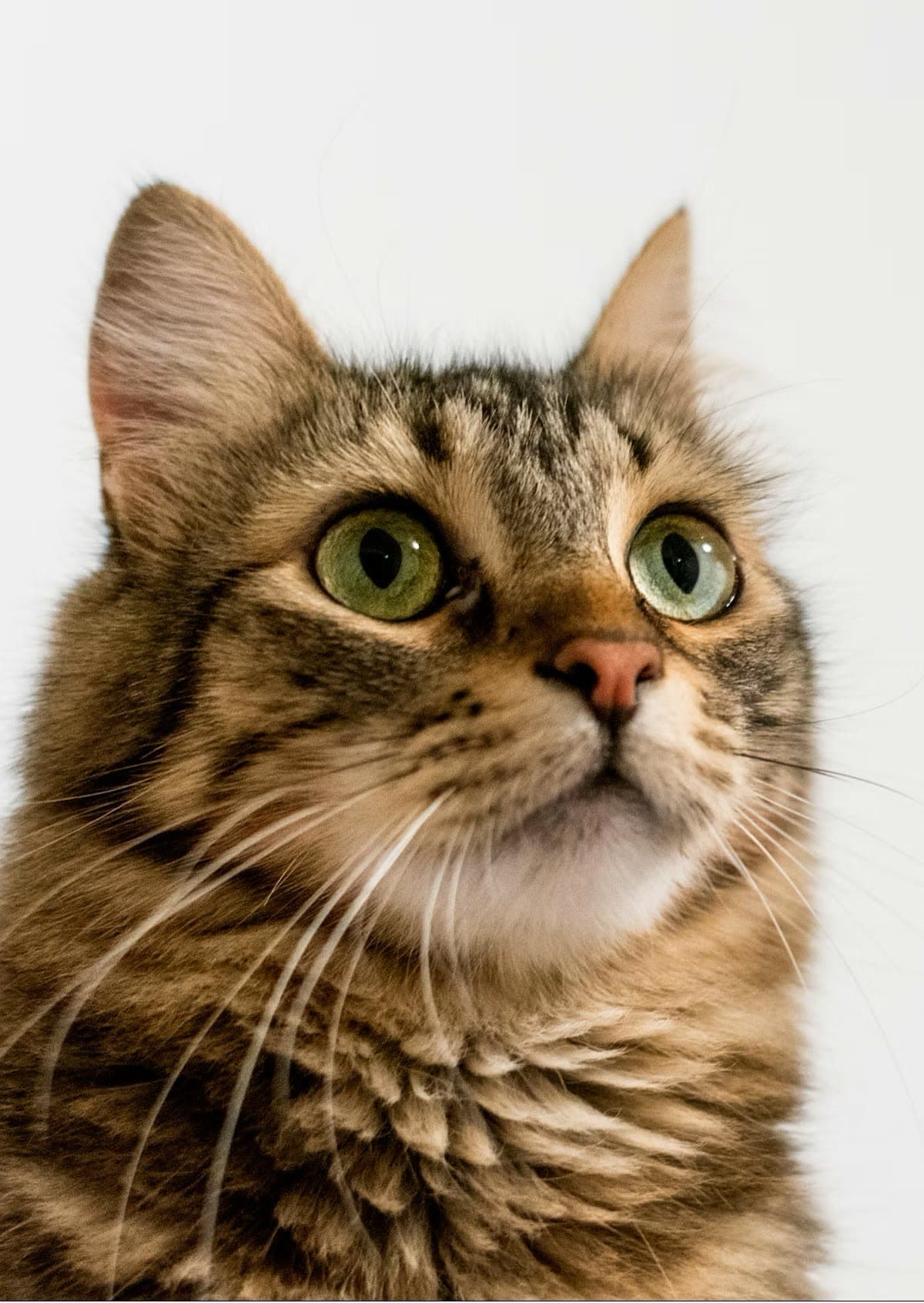
A cat's eyes are one of the most powerful communication tools in the animal world. Pupil size, gaze direction and blink frequency say more than a thousand meows.
- The slow blink — the absolute hit of feline communication, called the "cat kiss." When a cat looks at you and slowly closes its eyes, it's saying: "I trust you enough to close my eyes in your presence." You can reply with the same gesture.
- Dilated pupils — large, round pupils (in normal lighting) signal strong emotional arousal: excitement, fear, hunter mode or surprise. Context is key.
- Constricted pupils (vertical slits) — in normal lighting they can signal confidence, focus or offensive aggression. A cat with narrow pupils and flattened ears is a cat ready to attack.
- Intense, fixed staring — in the world of cats, direct, prolonged eye contact is a challenge and a threat. That's why cats often approach the people who don't like them — because those people avoid eye contact!
- Looking away — a conciliatory gesture, the message "I'm no threat."
Cats respond to humans' slow blinking and are more inclined to approach people who use this technique. This is the first experimental evidence that a cross-species "positive emotional dialogue" really works.
— Humphrey et al., University of Sussex, 2020
The whiskers — an underrated communicator
A cat's whiskers (vibrissae) aren't just an organ of touch — their position is an excellent indicator of mood, one we rarely pay attention to.
- Whiskers stretched forward — the cat is interested, excited or in hunter mode. It extends the vibrissae forward to "scan" the space.
- Whiskers relaxed to the sides — a neutral position: calm and relaxation.
- Whiskers pressed against the muzzle — a signal of fear, stress or discomfort. The cat is trying to "make itself smaller" by drawing in the vibrissae.
Body posture
A cat's overall posture is the sum of all its signals. Learn to read the full picture, not just individual elements.
- Exposed belly — one of the most often misread feline signals. The cat is expressing deep trust — the belly is the most sensitive part of the body. BUT — this is NOT an invitation to pet it! Most cats will respond to a touch on the belly by grabbing your hand with their claws. The cat showed you trust, not a wish.
- Arched back — depending on context, this can mean two things: a bristled cat with an arched back is fear and an attempt to look bigger. But a kitten with an arched back, hopping sideways? That's pure joy of play — the "cat disco."
- The loaf position — the cat sits with its paws tucked under its body. A position that's relaxed but alert — ready to get up quickly.
- Lying on its side with paws stretched out — a position of deep trust and total relaxation. It's the highest compliment a cat can pay you.
The best moment of the day: a slow blink from across the room
When a cat lies down, looks at you and slowly closes its eyes — reply in kind. A slow blink is a declaration of mutual trust. It doesn't require being right up close; it works at a distance too.
Vocalizations — an alphabet of sound
Although a cat's language is above all body language, vocalizations are an important supplement — especially in communicating with humans.
25-150 Hz
The vibrations of purring fall within a band that favors bone healing and tissue regeneration. It's a self-healing mechanism — including (especially!) when a cat purrs from pain or stress.
- Purring — contrary to popular belief, purring does NOT always mean happiness. Cats also purr when they feel pain, stress or anxiety. A cat purring at the vet isn't saying "I feel good" — it's saying "I'm trying to calm myself."
- Chirping (chattering) — rapid sounds while watching birds, an expression of hunting excitement and frustration. Some ethologists suggest it's an instinctive imitation of the sound of the killing bite.
- Hissing — an unambiguous warning signal: "Leave me alone or I'll attack." Never punish a cat for hissing — it's its right to express a boundary.
- Growling — deeper and more serious than hissing. It signals real aggression and a readiness to fight. Back off immediately.
- Meowing — the most fascinating sound in a cat's repertoire, directed almost exclusively at humans. Adult cats don't meow at one another — it's a behavior from kittenhood, "preserved" specifically for communicating with their owners. Every cat develops its own vocabulary of meows, tailored to the responses of its specific human.
Summary — your cat is speaking. Are you listening?
Every cat is an individual. Although the general rules for interpreting body language are universal, your cat has its own unique ways of expressing emotion. One cat shows joy by vigorously flicking its tail, another — by quiet purring. One shows trust by lying on its back, another — by sitting on your lap with its back to you (yes — turning its back is a compliment!).
The key is observation and patience. Spend time simply watching your cat — no phone, no TV. Notice how it reacts to different situations, what signals it sends before a meal, during play, in the presence of guests. Over time you'll learn to read it like an open book.
When you truly understand your cat's body language, your relationship will change beyond recognition. You'll stop being "the one who gives food" — and become a partner the cat understands and trusts.
Start today. Sit down beside your cat. Blink at it slowly. And wait for a reply. Because it will surely come — you just have to know where to look.
Sources
- Humphrey T., Proops L., Forman J., Spooner R., McComb K. (2020). The role of cat eye narrowing movements in cat–human communication. Scientific Reports, 10, 16503.
- Bradshaw J.W.S. (2016). Sociality in cats: A comparative review. Journal of Veterinary Behavior, 11, 113–124.
- Vitale Shreve K.R., Mehrkam L.R., Udell M.A.R. (2017). Social interaction, food, scent or toys? A formal assessment of domestic pet and shelter cat (Felis silvestris catus) preferences. Behavioural Processes, 141, 322–328.
- Schötz S., van de Weijer J. (2014). A study of human perception of intonation in domestic cat meows. Speech Prosody 7, 889–893.
- von Muggenthaler E. (2001). The felid purr: A bio-mechanical healing mechanism. Journal of the Acoustical Society of America, 110(5), 2666.
Frequently asked
Why does my cat bite me after I pet it?
It's "overstimulation." The cat sent a warning signal — a vigorously swishing tail, a skin twitch, flattened ears — that you missed. Next time, watch the tail and break contact before the signals escalate.
Does a cat showing its belly want to be petted?
No. An exposed belly is a signal of deep trust, but NOT an invitation to touch. The belly is the most sensitive part of a cat's body, and most cats will respond by grabbing your hand with their claws. Appreciate the gesture, don't pet.
What does the "cat disco" mean — an arched back and a sideways stance?
It's joyful play, most often in young cats. An arched back combined with a sideways, hopping gait is pure euphoria. It's a different signal from a bristled, stiff cat in fear — context and the position of the paws are key.
Does my cat understand me when I talk to it?
Partly. Research shows that cats recognize their owner's voice and respond to tone — they treat a higher, "chirpy" voice as an invitation to interact. The best channel, though, is body language: a slow blink and an open posture work more powerfully than words.
Why do adult cats meow only at humans?
Because we bred this behavior into them. Cats communicate vocally with each other almost exclusively during kittenhood — an adult cat that meows at another cat is a rarity. Meowing at a human is a learned "dialect" tailored to the responses of a specific owner.