Your cat has just eaten its third blade of grass from the pot on the windowsill, and you're already reaching for the phone to call the vet? Relax. Cats eating grass is one of the most frequently misinterpreted behaviors of our feline companions. For years people have repeated that a cat eats grass because it's sick, because it wants to vomit, or because "it's missing something."
Science says something entirely different — and it's fascinating.
Myth number one: "A cat eats grass because it's sick"
This is probably the most frequently repeated piece of "folk wisdom" about cats. Your cat ate grass? It must be feeling unwell. Something is surely bothering it. Maybe its tummy hurts?
Researchers from the University of California (Hart, Hart and Thigpen) decided to check. In two large survey studies conducted in 2006 and 2016, they surveyed over 2000 cat owners, asking about their animals' plant-eating behaviors.
6-9%
Only six to nine percent of cats showed any signs of illness before eating grass. Over 90% of cats that regularly reached for plants were perfectly healthy — no vomiting, no diarrhea, no discomfort.
The researchers' conclusion is unequivocal: the illness hypothesis finds no support in the data. Cats don't eat grass because they're sick.
Only 6-9% of cats showed signs of illness before eating plants — meaning that over 90% of grass-eating cats were perfectly healthy.
— Hart, Hart, Thigpen and Willits, 2021
Myth number two: "A cat eats grass to make itself vomit"
The second most popular myth. A cat ate grass and then vomited on the rug — so "it must have eaten it for that reason." Logical? Only at first glance.
The data show that 27-37% of cats vomit after eating grass. That means the majority — between 63 and 73% — don't vomit at all. If the goal of eating grass were to induce vomiting, it would be an exceptionally ineffective mechanism, working in fewer than one in three cats.
Vomiting after eating grass is more of a side effect than a goal. Mechanical irritation of the stomach by sharp blades may trigger a vomiting reflex in some cats — but in most it simply doesn't. The grass passes through the digestive tract and is excreted in the feces.
Myth number three: "A cat eats grass for hairballs" — and why the forums are partly right
The hairball theory seems intuitive — a cat swallows fur while grooming, and grass helps it vomit the fur up. Since long-haired cats swallow more fur, they should eat more grass. Simple, right?
Except that hard data say the opposite. Short-haired and long-haired cats eat grass with identical frequency — 83-85%. If the evolutionary goal were combating fur, Persians and Maine Coons should "graze" far more often than moggies. They don't. The hairball hypothesis — as the main evolutionary purpose — has been debunked.
But this doesn't mean grass doesn't help with de-shedding. Here academic science meets the intuition of experienced owners on the forums. True, nature didn't invent this instinct specifically with fur in mind, but grass in the stomach does exactly what it was created for — it sweeps.
Because our domestic cats are regularly dewormed, the grass "broom" rarely encounters parasites. Instead it encounters tufts of fur. And it deals with them brilliantly, in two ways:
- Cleaning "from the top" (vomiting) — sharp, rough blades irritate the stomach lining, forcing the cat to bring up a matted hairball (a bezoar) before it can block the intestines.
- Cleaning "from the bottom" (with the feces) — this route is mentioned least often, and it applies to those ~70% of cats that don't vomit after grass at all. Undigested, fibrous blades act like a powerful mechanical fiber. They move along the entire length of the gut, pushing the swallowed fur along to the litter box. They work like a "drain snake."
Forum + evolution: both are right
When you read on a forum that "grass is great for de-shedding" — that's the absolute truth. Evolution produced this "tool" to fight worms, but today it also works wonderfully for tidying up fur. It's a useful side effect of an ancient instinct.
The real reason: an evolutionary parasite-control mechanism
If a cat doesn't eat grass because of illness, vomiting or fur — then why? The answer proposed by scientists is rooted deep in predator evolution.
Eating grass is an innate, instinctive mechanism for controlling intestinal parasites.
Evidence from the wild
Analysis of the droppings of wild cats and canids consistently reveals the presence of grass and other plants in the feces. Wild cats regularly eat grass — not because they lack meat, and not because they're sick. They do it systematically, as part of a natural behavioral repertoire.
A particularly compelling discovery comes from studies of civet droppings. Scientists found in them whole, undigested blades of grass with adult Toxocara sp. nematodes tangled in them. The grass acted as a physical trap — the fibrous blades wound around the worms and helped expel them along with the feces.
This is no accident, but a deliberate cleansing mechanism.
The scale of the phenomenon among predators
124 / 352
A review of 352 studies of carnivorous species found consumption of fibrous plant material in 124 species. This is not a quirk of domestic cats — it's a widespread behavioral pattern among predators worldwide.
Wolves eat grass. Foxes eat grass. Lynxes eat grass. And they all do it for the same evolutionary reason.
A review of 352 studies of predators found consumption of plant material in 124 species — with evidence linking this behavior to the expulsion of intestinal parasites.
— Hart et al., 2021 — Animals (Basel)
Why do young cats eat grass more often?
One of the most interesting findings from Hart's research is an age-related pattern. Young cats, under 2-3 years old, eat grass far more often than older ones. At the same time, young cats vomit after grass less often than older ones.
This pattern fits the parasite hypothesis perfectly. Young animals have an immature immune system and are more vulnerable to parasitic infections. It makes evolutionary sense for the protective mechanism to be stronger in those who need it most. If "sick" cats ate grass, then older individuals (with naturally more health problems) should eat it more often. They don't. If it were about hairballs, age wouldn't matter. And yet younger cats eat grass decidedly more often.
How does it work? The cleansing mechanism
The process is elegantly simple and purely mechanical:
- The cat eats blades of grass — indigestible, fibrous, with a rough surface.
- The grass passes through the digestive tract — cats lack the enzymes to break down cellulose. The blades keep their structure.
- The fibers mechanically increase intestinal peristalsis — the wave-like motion speeds up.
- Parasites become physically tangled in the blades — the undigested fibers wind around the worms like a dense net.
- The parasites are excreted with the feces — together with the undigested grass.
The whole process is preventive in nature — a cat doesn't have to be currently infected to eat grass. It's an instinctive behavior, inherited genetically, operating "just in case."
That's why your dewormed kitten, who never sets foot outside the flat, still happily reaches for grass from the pot. Its body doesn't know it lives in a sterile flat on the third floor. Its genes still whisper: "eat the grass, just in case."
What does this mean for a cat's owner?
Give your cat access to grass
Since eating grass is a natural, instinctive need — don't fight it, satisfy it. Put a pot of cat grass on the windowsill. Barley, oat or wheat grass — any will do. A cat with access to safe grass will be less interested in potentially toxic houseplants.
Don't panic over vomiting
If a cat ate grass and brought it back up — that's normal. It happens in one in three cats and is no reason for a vet visit, as long as the vomiting is a one-off and the cat behaves normally. The situation is different when a cat vomits repeatedly, refuses food or is lethargic — then consult a vet, but the cause is certainly not the grass itself.
Avoid chemicals on lawns
If your cat has access to a garden, make sure the grass is not treated with pesticides, herbicides or synthetic fertilizers. Residential lawns and parks are sometimes sprayed with chemicals toxic to animals. The safest option is always grass from your own organic crop.
Don't give up deworming
The fact that eating grass is an evolutionary parasite-control mechanism does not mean it replaces regular fecal testing and deworming. Grass may mechanically help expel worms, but it does not eliminate them entirely. Parasite prevention at the vet clinic is still the absolute foundation.
Grass-eating and the BARF diet
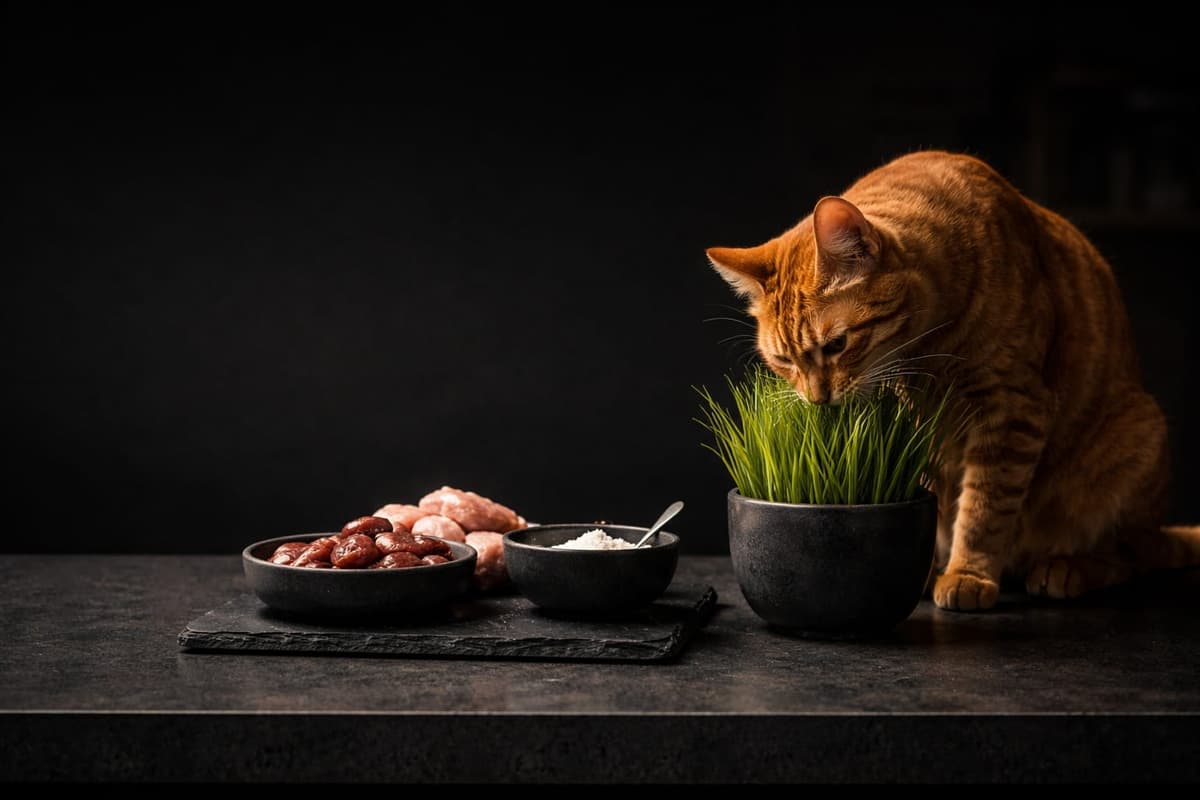
If you feed your cat a raw diet, this topic takes on extra significance. In a predator's natural diet, the role of "fiber" is played by the indigestible elements of prey — fur, feathers, sinews, cartilage. They pass through the digestive tract, mechanically cleaning it — exactly as grass does.
In the classic BARF diet (based on pure ground meat) this natural, animal fiber is often missing. A cat fed this way may instinctively reach for grass more often, compensating for the lack of indigestible fibers in its meals. This isn't a sign of a nutrient deficiency, but an attempt to supplement the mechanical function of the digestive system.
If you feed your cat BARF and see that it happily eats grass — let it. It's an excellent, natural supplement. And if you want to get even closer to the evolutionary feeding model, consider whole-prey elements (feeder mice, chicks, quail with feathers), which will provide this natural support for peristalsis.
Summary
Cats eating grass is not a symptom of illness, not a desire to induce vomiting, and not a hairball remedy. It's an innate, evolutionary mechanism for controlling intestinal parasites — an instinct inherited from wild ancestors, working preventively regardless of how clean your flat is.
The best thing you can do? Give your cat its own pot of grass and stop worrying. This little green ritual is nothing other than millions of years of evolution in action.
Sources
- Hart B.L., Hart L.A., Thigpen A.P., Willits N.H. (2021). Characteristics of Plant Eating in Domestic Cats. Animals (Basel), 11(6), 1853. PMC 8300339.
- Hart B.L., Hart L.A., Thigpen A.P., Tran A., Bain M. (2019). The paradox of canine conspecific coprophagy. Veterinary Medicine and Science, 4(2), 106–114.
- Huffman M.A. (2003). Animal self-medication and ethno-medicine: exploration and exploitation of the medicinal properties of plants. Proceedings of the Nutrition Society, 62(2), 371–381.
- Engel C. (2002). Wild Health: How Animals Keep Themselves Well and What We Can Learn From Them. Houghton Mifflin.
Frequently asked
Can I give my cat ordinary grass from the lawn?
Better not. Residential lawns and parks are sometimes sprayed with pesticides, herbicides and synthetic fertilizers that are toxic to animals. Put a pot of barley, oat or wheat grass on the windowsill — it's safe, controlled and costs next to nothing.
My cat vomited after eating grass. Is it something serious?
No, if the vomiting is a one-off and the cat behaves normally. It happens in 27-37% of cats after eating grass and is a mechanical side effect. Consult a vet only if the cat vomits repeatedly, refuses food or is lethargic — then the cause lies elsewhere.
My cat eats grass despite regular deworming. Why?
Because it's an instinct programmed into a predator's genes, operating regardless of current health. Your dewormed grass-eating cat is doing exactly what wild cats have done for millions of years — preventively, "just in case." Don't fight it.
Does eating grass replace deworming?
Absolutely not. Grass may mechanically help expel some worms, but it does not eliminate them entirely. Parasite prevention at the vet clinic is still the foundation. Grass is support, not a cure.
I feed my cat BARF — does it need grass?
It may want it more often. The classic BARF diet (pure ground meat) lacks the indigestible fibers that fur, feathers and sinews provide in natural prey. A cat instinctively compensates for their absence with grass. Let it — or reach for whole-prey elements (feeder mice, feathered chicks).