Your cat has just jumped onto the counter and is trying to dip a paw into your yogurt. Or it's licking the last of the ice cream from the bowl. Or begging for a piece of cake. And you think to yourself: "well, would you look at that — my cat has a sweet tooth!"
It doesn't. At all. Not even a little.
What looks like a love of sweets is a fascinating story about evolution, genes and how millions of years of predation shaped your cat's palate. And it has a few surprises.
The broken gene: Tas1r2
In 2005, a team of researchers from the Monell Chemical Senses Center in Philadelphia published a breakthrough finding in PLoS Genetics. Li and colleagues examined the taste-receptor genes of six unrelated domestic cats, a tiger and a cheetah.
The result? The Tas1r2 gene — the key element of the sweet-taste receptor — is a pseudogene in cats. That is, a gene that once worked but "broke" and no longer produces a functional protein.
Specifically, the researchers found two errors in the feline DNA:
- A 247-base-pair microdeletion — a sizeable, crucial chunk of the gene vanished from the DNA sequence, making the receptor's "build instruction" unreadable.
- Stop codons — evolutionary "stop reading here" signals that prematurely halt protein production.
To make sure that feline taste buds really don't respond to sweetness, the scientists checked it in three ways:
- RT-PCR (looking for mRNA) — whether the cells produce a biological "instruction." Result: zero.
- In situ hybridization — searching directly for the instruction in tongue tissue. Result: nothing.
- Immunohistochemistry — searching for the finished protein in the taste buds. Result: in cats the protein simply doesn't exist.
For comparison — the receptor's second element, T1R3, works normally in cats. The protein is there, the gene is intact. The problem is that the sweet-taste receptor works like a lock with two keys. You have one half, the other is missing — the door won't open.
Most intriguingly, the identical mutation was found in the tiger and the cheetah. This means the gene damage occurred in the common ancestor of all cats, probably millions of years ago, before the Felidae family split into species.
This molecular change was very likely an important event in the evolution of the cat's carnivorous behavior.
— Li et al., 2005 — PLoS Genetics
Not only cats: who else lost sweet taste?
Here we need to debunk a popular myth. Cats are not the only mammals that can't taste sweetness.
In 2012, Jiang and colleagues published a study in the Proceedings of the National Academy of Sciences (PNAS) in which they examined the Tas1r2 gene across 12 species of the order Carnivora. The result: 7 of the 12 species had a permanently damaged Tas1r2 gene — but this applied only to those animals that are strict carnivores.
7 / 12
All cats, seals, sea lions, the Asian otter and dolphins lost a functional sweet-taste receptor. The pattern: the more strictly carnivorous the species, the greater the likelihood it lost the receptor.
Who else lost sweet taste:
- All cats (domestic cats, tigers, cheetahs, lions).
- The Asian otter.
- Sea lions.
- Seals.
- Dolphins (which additionally lost umami and bitter taste).
Who kept it:
- Dogs — they also eat fruit and plant scraps.
- Ferrets — occasionally eat fruit.
- Giant pandas — eat bamboo (despite belonging to the Carnivora).
- Bears — omnivores.
The pattern is clear: the more strictly carnivorous the species, the greater the likelihood it lost the sweet-taste receptor. Evolution is pragmatic — if in the wild you eat only meat and don't need carbohydrates, the unused receptor fades away.
A behavioral test confirmed it perfectly: the Asian otter (with the broken gene) showed no interest in sugar water. The spectacled bear (intact gene), on the other hand, clearly preferred sweet water.
But dolphins beat all records: they lost all three taste receptors and probably have no functional bitter-taste receptors either. They swallow fish whole, without chewing — taste is of no use to them.
If not sweet — then what actually tastes good to your cat?
Cats have only about 480 taste buds. For comparison, humans have around 9000. But that doesn't mean a cat's sense of taste is poor. It's simply very highly specialized.
480 vs 9000
A cat has 19 times fewer taste buds than a human — but each one is exquisitely tuned to detect the substances present in fresh meat. Quantity was replaced by specialized quality.
Umami — the predator's main taste
A landmark 2023 study by McGrane and colleagues (Chemical Senses) showed that umami is the cat's main and favorite taste. The umami receptor works superbly in cats — and is tuned to detect the chemical signals present in fresh meat.
What stimulates a cat's taste buds?
Nucleotides — the basic "building blocks" of cells (DNA and RNA), which are released in high concentrations in fresh meat:
- IMP (inosine monophosphate) — the main trigger; cats clearly preferred water with added IMP over plain water.
- GMP, CMP, UMP — other nucleotides, with similarly strong interest in the food.
Amino acids (the building blocks of proteins) — with a surprise. In humans, glutamic acid (the well-known MSG) is the quintessence of umami. In cats, glutamate doesn't work at all. Instead, cats respond to 11 other amino acids, but only in a duet with nucleotides:
- L-histidine — the clear favorite. A stronger response than to any other amino acid.
- L-alanine, L-asparagine, L-cysteine, glycine, L-leucine, L-methionine, L-phenylalanine, L-serine, L-tryptophan, L-tyrosine.
Interestingly, 5 of the 10 essential amino acids (vital to life, not produced by the body) are strong umami activators. Evolution linked nutritional need with taste — a cat takes pleasure in eating exactly what it biologically needs.
Why do cats love tuna?
The McGrane study solved an age-old riddle: why do cats go crazy for tuna?
Tuna has a unique chemical combination, perfectly matched to the feline umami receptor:
| Component | Tuna | Other meat (chicken, beef) |
|---|---|---|
| IMP | 8.4–10 mM | Comparable |
| Free L-histidine | 7.9–89.5 mM | Undetectable or trace |
Tuna contains hundreds of times more free histidine than any other meat. And histidine is the absolute favorite of the feline umami receptor. It's not so much that a cat "likes tuna" — its taste buds are literally evolutionarily designed to respond most strongly to the specific chemical combination that tuna has in excess.
Bitter taste — the toxic alarm
Cats have at least 7 different bitter-taste receptors. This may seem strange — why would a carnivore need to detect bitter substances, mainly associated with poisonous plants?
The answer is simple: bitter taste serves a cat to detect spoiled meat. When protein breaks down, bitter chemical compounds form that not only activate the bitter-taste receptors but simultaneously block the umami receptors. A double safety system: spoiled meat tastes bitter and immediately stops tasting like meat.
Salty and sour — less studied
Cats respond to salty and sour tastes, but more weakly than other species. A curious fact: cats don't respond to the low salt concentrations that elicit a response in other mammals. Probably because fresh meat naturally contains enough sodium — a predator doesn't have to actively seek it out.
So what is your cat after when it begs for your food?
Let's return to the yogurt, ice cream and cake from the start of the article. Your cat doesn't sense sugar there. At all. But it unfailingly detects other components:
| What you're eating | What your cat senses |
|---|---|
| Vanilla ice cream | Milk fat + casein protein → umami + a high-fat signal |
| Yogurt | Fat + amino acids from milk fermentation → strong umami |
| Butter cake | Butter (animal fat) + eggs (protein) → umami + fat |
| Sweet coffee creamer | Pure cream fat → an instinctive craving for calorie-dense food |
| Banana | No response — typically human plant carbohydrates are unappealing to a cat's nose |
| Chocolate | Cocoa fat (WARNING: chocolate is highly toxic to cats!) |
Your cat is a biological detector of animal fat and protein. Sugar, starch, fiber — completely indifferent. Its palate is tuned to one thing: fresh meat.
What does this mean for a cat's diet?
1. Dry food "tastes good" to a cat not because it's healthy
Dry-food manufacturers know that a cat won't respond to carbohydrates or starch — and those are the main ingredients of kibble. That's why they use palatants — artificial flavor coatings sprayed onto the kibble at the end of production.
Palatants contain heavily processed proteins, animal fats and so-called pyrophosphates. The latter are a clever chemical trick — they artificially and forcefully stimulate the feline umami receptor, fooling the brain into thinking it's eating fresh meat. Without these chemical aids, a cat probably wouldn't even touch dry food.
It's a bit like dousing a piece of styrofoam in an intense meat sauce and insisting to everyone that "the cat loves styrofoam."
Palatants: chemically fooling the feline umami sense
Dry food without palatants = a cat won't touch it. It's that simple. Pyrophosphates artificially activate the umami receptor so forcefully that the cat's brain perceives the kibble as fresh meat. Manufacturers don't hide this — it's standard technology. The question is: does your cat deserve styrofoam doused in sauce, or real meat?
2. BARF hits a cat's taste naturally
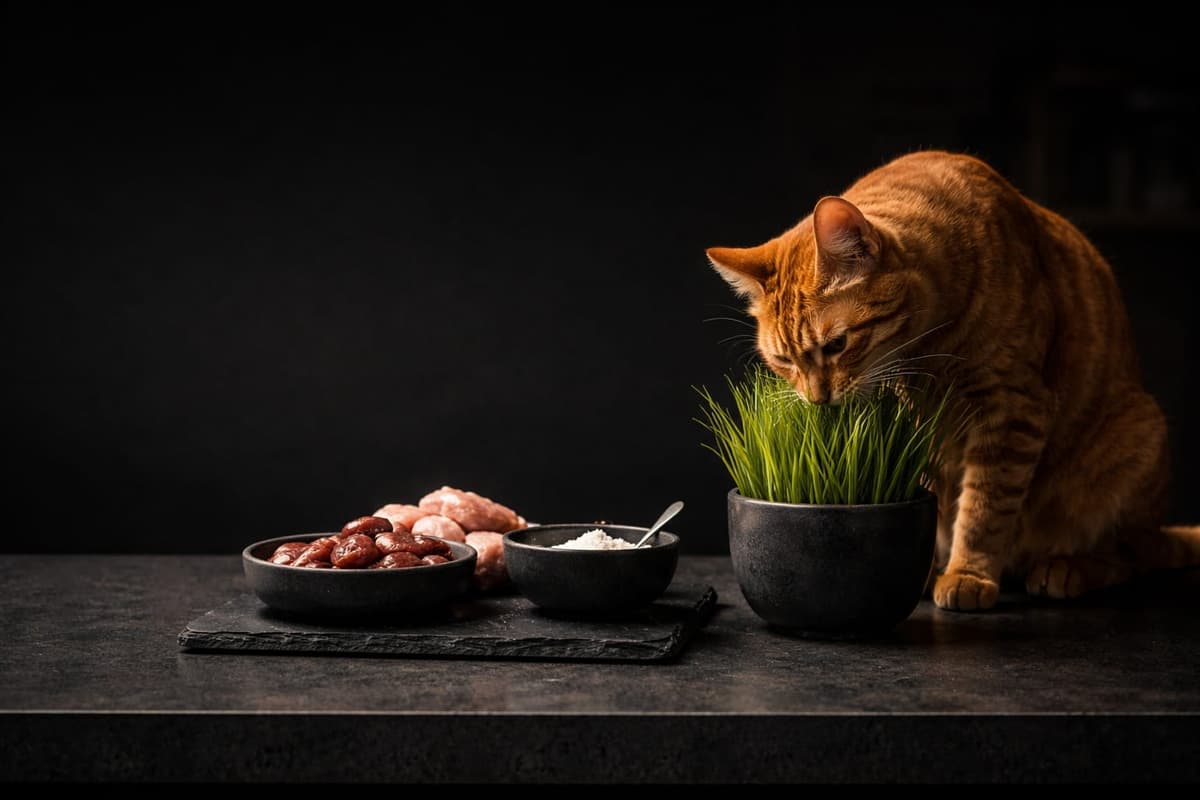
Raw meat contains exactly what the feline umami receptor has been tuned to for millions of years:
- Nucleotides — naturally present in fresh muscle.
- Free amino acids (histidine, leucine) — readily available without processing.
- Animal fat — a natural, legible jolt of energy.
When you choose BARF, you don't need palatants, artificial aromas or "enhancers." Raw meat tastes good to a cat for a simple reason — its palate evolved to take pleasure in it.
3. A cat's "pickiness" isn't a whim — it's biology
If your cat refuses certain cans or kibbles, it isn't spoiled. Its taste receptors are telling it that this food doesn't contain the right nutrients. A cat is looking for umami and animal fat. If the food is mostly starch with a chemical "coating," a cat's nose can see through the ruse.
4. Tuna is a treat, not a diet
Eating tuna hits a cat's umami receptor the way a strong espresso hits a human. Unfortunately, feeding a cat tuna alone is a big mistake. As a dietary staple it is unbalanced — too much phosphorus, too little taurine, a risk of heavy-metal poisoning (mercury). Cats love it because the reward system in their brain responds to this strong umami stimulus. Treat it as a fine treat for special occasions, not an everyday meal.
Summary: five taste facts about your cat
- Your cat can't taste sweetness — the gene responsible broke millions of years ago. Dolphins, seals and otters lost it too.
- Umami is the cat's main taste — its tongue is programmed to detect the substances present in fresh meat.
- Cats have 480 taste buds (humans: 9000) — which doesn't mean they have no sense of taste. Their senses are sharply specialized for eating meat.
- Tuna is an explosive mix for a cat — it has an enormous concentration of substances that strongly stimulate feline taste buds.
- Bitter taste is an alarm system — it helps detect spoiled meat, protecting the animal from poisoning.
The next time your cat jumps onto the counter and goes for your ice cream — know that it's not about the sugar. Its millions of years of evolution are telling it: "there's fat and animal protein there — take it." From a biological standpoint, it's right.
But we do have to be careful. Though feline instincts are remarkably precise in the wild, our human food hides traps. A cake or dessert may contain ingredients that are toxic to a cat (chocolate, raisins, artificial sweeteners like xylitol), and your cat could unknowingly harm itself. So rather than agreeing to the theft of human desserts, let's offer it what is safest and healthiest for a predator — properly balanced meat.
Sources
- Li X. et al. (2005). Pseudogenization of a Sweet-Receptor Gene Accounts for Cats' Indifference toward Sugar. PLoS Genetics, 1(1), e3.
- Jiang P. et al. (2012). Major taste loss in carnivorous mammals. Proceedings of the National Academy of Sciences (PNAS), 109(13), 4956–4961.
- McGrane S.J. et al. (2023). Umami taste perception and preferences of the domestic cat (Felis catus), an obligate carnivore. Chemical Senses, 48, bjad026.
- Beauchamp G.K. et al. (2006). Cats Lack a Sweet Taste Receptor. Journal of Nutrition, 136(7 Suppl), 1932S–1934S.
- Lei W. et al. (2015). Functional Analyses of Bitter Taste Receptors in Domestic Cats. PLoS One, 10(10), e0139670.
Frequently asked
My cat loves ice cream — surely it can taste sweetness?
No. The cat detects the milk fat and casein protein in ice cream, NOT the sugar. Same with yogurt (fat + amino acids from fermentation) and cake (butter + eggs). Sugar is biologically invisible to it — the receptor simply doesn't exist.
If cats love tuna so much, why shouldn't they eat it often?
Because tuna is a treat, not a diet. As a staple it's unbalanced — too much phosphorus, too little taurine, a risk of heavy-metal poisoning (mercury). Give it once a week as a treat. The everyday diet is a balanced BARF or wet food with a good meat profile.
Is my cat being "picky" when it refuses food?
It's not a whim, it's biology. Feline receptors detect umami (fresh meat, nucleotides, histidine) and reject what doesn't contain it. If the food is starch with a chemical flavor "coating," a cat's nose can see through it. Your cat isn't protesting — it's diagnosing.
Does bitter taste protect a cat from poisoning?
Yes — that's its main function. Cats have at least 7 bitter-taste receptors that detect the protein-breakdown compounds in spoiled meat. What's more, bitter compounds block the umami receptors, so spoiled meat stops tasting like meat. A double safeguard.
What about fruits and vegetables in a BARF diet, then?
For a cat they are taste-neutral (it senses neither sweetness nor fiber) and biologically unnecessary. Classic BARF for cats limits their share to an absolute minimum (1-3%) or omits them entirely. A cat is an obligate carnivore — its physiology works optimally on animal protein and fat.