Your cat's food has 30% protein. Sounds good? The label says 'rich in protein'. The vet doesn't object. The cat eats it happily.
But that same food has 20% fat and 35% carbohydrate. Suddenly those 30% of protein — which looked so good on paper — are not what they seem.
In feeding a cat, it isn't only about how much protein is in the bowl. What matters is how much protein there is per calorie the cat eats. When you add fat — which has more than twice the calories of protein — those proportions get drastically distorted. And that is exactly where the problems begin — the ones manufacturers don't mention on the label.
What would a cat eat if it could choose?
The study that let cats decide
In 2011, a team led by Adrian Hewson-Hughes at the Waltham Centre for Pet Nutrition published in the Journal of Experimental Biology one of the best-designed studies in the history of feline nutrition.
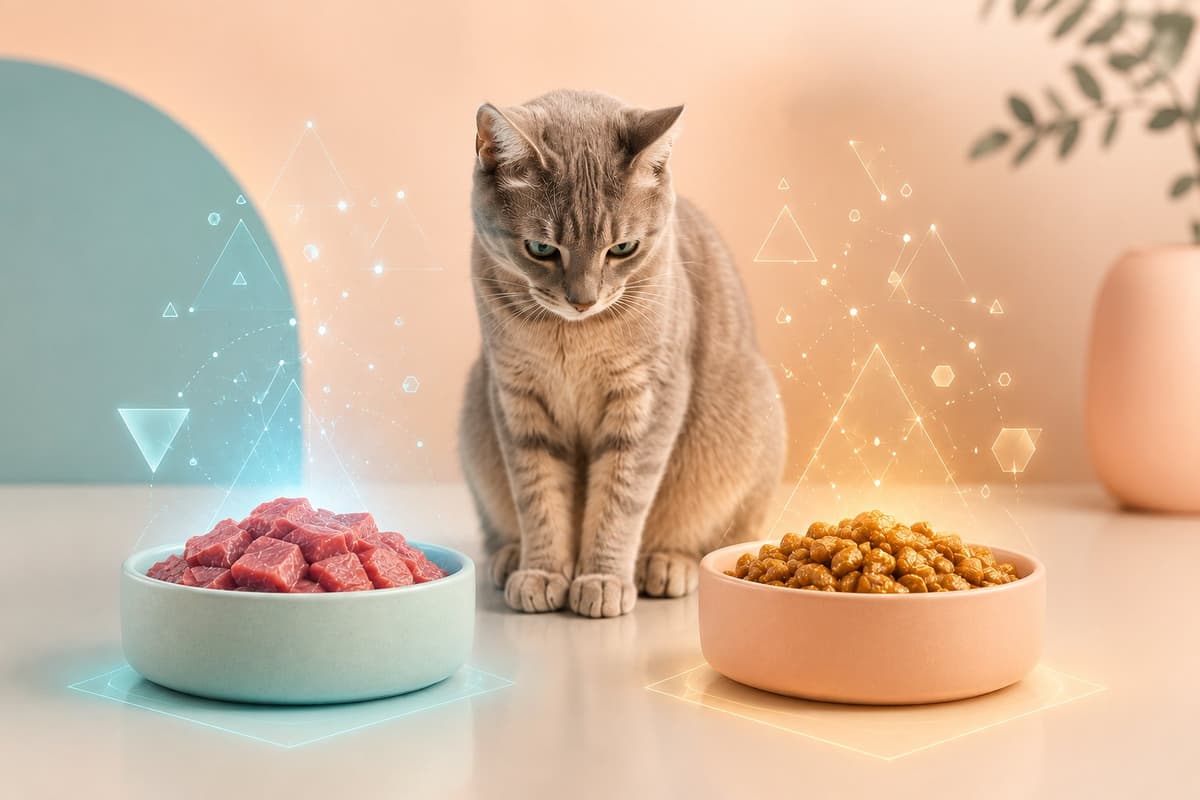
Instead of dictating what cats should eat, the researchers gave them free choice. The cats were offered several foods with different macronutrient profiles at once — high-protein, high-fat and high-carbohydrate — and could eat as much as they wanted from each bowl.
The researchers used what is known as geometric analysis — an innovative method that reveals how organisms instinctively balance the intake of several macronutrients at the same time. They overlaid macronutrient triangles and intake plots onto the data to see which composition the cats actively chose.
The result: the feline 'nutritional target'
The cats consistently steered towards a diet with the following proportions:
Protein:       52% of energy
Fat:           36% of energy
Carbohydrate:  12% of energy
This is no accident or statistical artefact. It is a macronutrient target — an evolutionarily shaped, ideal nutritional ratio that cats actively regulate towards, selecting from different bowls to land precisely on this result.
Three findings that change the picture
1. The carbohydrate ceiling
Cats had a hard limit (a carbohydrate ceiling) — the maximum amount of carbohydrate their body could process without adverse consequences (about 300 kJ per day, roughly 20 g). When the only food available was the high-carbohydrate one, cats preferred to eat less and go hungry rather than exceed that limit. This happened even at the cost of a protein and fat deficit.
Hewson-Hughes explains this by the absence of hepatic glucokinase — an enzyme that in humans allows rapid metabolism of dietary glucose. The cat lacks this enzyme, so excess carbohydrate literally floods and overloads its metabolism.
2. The protein priority
Of the three main macronutrients, cats regulated protein intake most strongly. On diets where the ideal target (52:36:12) was unattainable, cats tried above all to maintain an adequate protein level — even at the price of excessive fat intake.
3. No ceiling on fat
This is where the problem starts. Cats had a natural limit on carbohydrate and prioritised protein, but they had no hard physiological brake on fat intake. When the only route to enough protein ran through a high-fat diet, cats ate the excess fat with no restraint whatsoever.
That is precisely why a high-fat food can be so dangerous: a cat trying to reach its natural protein requirement unwittingly overeats fat along the way.
How do we know what a cat's 'natural' diet is?
Analysing the composition of prey
Hewson-Hughes and his team didn't have to guess — studies exist that have broken natural feline prey down to its constituents in great detail.
Plantinga and colleagues (2011, British Journal of Nutrition) analysed the dietary profile of free-roaming cats from stomach studies and faecal analysis. Their results are as follows:
| Parameter | Cat's natural diet (% of metabolisable energy) |
|---|---|
| Protein | 52% |
| Fat | 46% |
| Carbohydrate | 2% |
The composition of specific prey items (on a dry-matter basis, DM):
| Prey | Protein (% DM) | Fat (% DM) | Carbohydrate (% DM) |
|---|---|---|---|
| Mice and rats | 55-63% | 20-31% | 0-3% |
| Birds | 64-69% | 9-15% | 1-3% |
| Rabbits | 60-65% | 15-25% | 1-2% |
| Fish | ~69% | ~9% | ~1% |
Note the key relationship: in a cat's natural diet, protein always dominates over fat. No natural feline prey exists in which fat content exceeds protein on a dry-matter basis. The ratio protein > fat is an absolute evolutionary constant. Any food that reverses this proportion drastically breaks the rules on which this species' metabolism was shaped.
Why is the protein-to-fat ratio more important than the amount of protein?
The calorie-density problem
Here we reach the heart of the matter. One gram of each macronutrient supplies a very different amount of energy:
1 g protein        = 4 kcal
1 g carbohydrate   = 4 kcal
1 g fat            = 9 kcal   (more than twice as much!)
What does this mean in practice? Let's look at two example foods:
Food A — 'high-protein': 45% protein, 15% fat, 20% carbohydrate. Per 100 g: 180 kcal from protein + 135 kcal from fat + 80 kcal from carbohydrate. Protein supplies 46% of energy — close to a cat's natural requirement.
Food B — 'with added fat': 30% protein, 25% fat, 30% carbohydrate. Per 100 g: 120 kcal from protein + 225 kcal from fat + 120 kcal from carbohydrate. Protein supplies only 26% of energy — half the feline optimum!
Both foods can boast an attractive double-digit protein percentage on the label. Yet from the standpoint of a cat's metabolism these are two completely different diets. In Food B, the high fat content energetically 'dilutes' the protein — for every calorie the cat eats, far fewer amino acids come along.
Protein-to-calorie ratio
This is why professional veterinary nutritionists rarely look solely at the crude protein percentage on the label. The key parameter is the protein-to-calorie ratio — the value showing how many grams of protein come with every 100 kcal of metabolisable energy:
| Reference point | g protein / 100 kcal |
|---|---|
| NRC minimum | 4.0 g |
| AAFCO minimum | 6.5 g |
| Maintaining muscle mass (Laflamme 2013) | ~8.1 g |
| Cat's natural diet (mouse) | ~12-14 g |
Note: the NRC (National Research Council) and AAFCO (Association of American Feed Control Officials) are the leading US institutions that set commercial nutritional standards for pet foods. They define, however, the absolute minimums needed for survival — not the optimal values that ensure health and longevity.
The gulf is plain to see. The NRC minimum (4.0 g) is three times lower than what a cat receives in its natural diet. A food that merely meets the AAFCO minimums is cleared for sale, even though its profile may be entirely insufficient to maintain an adult cat's lean muscle mass. And if we add yet more fat to such a diet, the consequences can be dramatic.
What happens when there's too much fat: four mechanisms of harm
1. Loss of muscle mass — the cat 'vanishes before your eyes'
A cat's enzymes responsible for protein catabolism (breakdown) work continuously at maximum capacity. Gluconeogenesis (producing the glucose the brain needs from proteins/amino acids) is in this species obligatory and constant. Simply to maintain hard-won muscle mass, a cat needs to take in about 5.2 g of protein per kilogram of body weight per day.
When excess fat appears in the food, two things happen. First, the food becomes extremely calorie-dense, so the cat eats a smaller volume (because it reaches its energy limit sooner), taking in far fewer grams of protein. Second, the protein-to-calorie ratio drops drastically. Even if the cat eats the same pool of calories, they come mainly from fat.
Because the cat's enzymes run at full tilt and gluconeogenesis absolutely requires amino acids, a body deprived of enough dietary protein begins to 'eat' and digest its own muscle.
Worst of all, routine bloodwork may be perfectly normal at this time. Studies have shown that nitrogen balance (a lab indicator comparing nitrogen taken in via the diet with nitrogen excreted, which in theory shows whether the body is starving) holds at a seemingly stable level in a cat on as little as 1.5 g of protein per kilogram of body weight. Yet to truly protect muscle from degradation, the cat needs 3.5 times more! The cat therefore slowly loses muscle tissue and gains fat tissue, while the number on the scale at the vet may stay unchanged.
2. Obesity and insulin resistance — the road to diabetes
Researchers Backus, Cave and Keisler (2007) ran an experiment in which cats were fed diets with a constant protein-to-calorie ratio but varying fat content at the expense of carbohydrate. The result overturned a common myth: it was a high fat level, not carbohydrate, that triggered a drastic gain in fat tissue and total body weight. Cats on a diet where 64% of energy came from fat gained 17% even before being neutered.
Feline obesity, however, is not just a matter of overloaded joints. Researcher Margarethe Hoenig showed that every extra kilogram of body weight (one that already gives the cat visible excess weight) lowers its insulin sensitivity by as much as 30%.
A study by Appleton and colleagues (2004), in turn, demonstrated that cats fed a high-fat diet showed:
- Prolonged glucose clearance time — meaning much slower removal of sugar from the blood. Excess circulating glucose is highly toxic to tissues and damages internal organs.
- A markedly reduced acute insulin response — in reaction to a meal eaten, the pancreas released far too little insulin, which is essential for cells to take up sugar.
- Signs of impaired, disrupted beta-cell function in the pancreas — these specific cells house the 'factories' that produce insulin. When, owing to excess fat, they begin to die off and become exhausted, the direct road to type 2 diabetes opens up.
3. Fatty liver (the number-one killer)
Fatty liver disease is an extremely dangerous condition in whose development a faulty protein-to-fat ratio is implicated.
The mechanism by which it arises is as follows: when large amounts of fatty acids surge into the liver (from a high-fat diet or from the sudden burning of the body's own fat tissue), the organ must somehow shed them so it doesn't become blocked. The liver therefore 'packs' that fat into special protein transporters called very-low-density lipoproteins (VLDL). Picture these lipoproteins as protein taxis that ferry fat out of the liver straight into the bloodstream.
The problem is that building these 'taxis' (apolipoproteins) requires high-quality protein. If there is too little of it in the diet (that is, the protein-to-fat ratio is extremely low), the liver has nothing to build the transporters from. As a result, the fatty acids cannot leave the organ. Instead of driving off, they accumulate directly in the hepatocytes (the basic cells that make up the liver), literally smothering them with fat from within. Cats are especially biologically predisposed to this.
4. Overeating — no brake on fat
As studies have shown, while cats possess a mechanism that blocks excessive carbohydrate intake, they have no such brake when it comes to fat. If a cat, driven by a strong instinct and a need for protein, is given a food low in protein but stuffed with fat, it will eat that fat with no restriction at all. It does so simply to satisfy its fundamental hunger for amino acids.
How much fat does a cat need?
Fat is not the enemy — it is an essential macronutrient. It supplies dense, concentrated energy (in a small volume fat delivers twice the calories of protein), valuable fatty acids (AA, EPA, DHA), fat-soluble vitamins (A, D, E, K) and is responsible for high palatability. There is, however, a line separating the body's requirement from a dangerous excess.
Fat in a cat's natural diet makes up about 36-46% of energy intake, but it occurs alongside a protein level of 52% of energy. This gives a safe protein-to-fat ratio of around 1.1–1.4 : 1 (on an energy basis). A food that reverses this proportion and favours fat is a metabolic mistake.
Connecting with other findings: the full picture
Gluconeogenesis and the B:F ratio
A cat's brain absolutely requires glucose obtained through gluconeogenesis from amino acids. A low supply of protein relative to a high supply of fat does not reduce the body's requirement, so the cat makes up the missing amino acids from its own muscle.
Temperature and the palatability of fat
Fat is a wonderful carrier of volatile aroma molecules released from warm food (read our article on why cats prefer warm meals). Food manufacturers know cats' evolutionary preferences perfectly well and widely use, on production lines, the phenomenon of fat coating. This involves spraying the outside of dry kibble with a layer of high-calorie fat that sends the animal an intense appetising signal. The result is a huge distortion of the natural macronutrient balance in commercial food.
Neophobia and a high-fat diet
Because of evolutionarily shaped neophobia (the natural, very strong fear of and reluctance to try new, unfamiliar food — learn the details of food neophobia in cats in our comprehensive guide), cats favour the food they came to know in their earliest weeks of life. A kitten fed exclusively dry, fat-coated food 'codes' this unhealthy macronutrient profile into its brain as the nutritional norm. Switching an adult cat later to a healthy, meat-based diet (e.g. BARF) often takes many weeks of careful, gradual introduction of new tastes and textures.
Practical tips: what to look for in a good food
To avoid the pitfalls of high-fat diets and protect your cat's metabolism, pay attention to the following indicators:
- Crude protein ≥40% on a dry-matter basis — the absolute minimum supporting the maintenance of good physical condition.
- Animal-source ingredients as the foundation — muscle meat, organs and fish first in the ingredient list.
- The protein/fat ratio on the label — the declared protein content should always be clearly higher than the declared fat content.
- Carbohydrate <15% on a dry-matter basis — follow the rule: the less, the better (bearing in mind the cat's rigid carbohydrate ceiling).
- Grams of protein per 100 kcal ≥8 g — the key threshold for avoiding muscle loss.
Your cat is a highly specialised, biology-shaped machine for processing protein. Fat is an important auxiliary fuel that does its job superbly in strictly defined proportions. If you upset that balance, the cat's metabolism will begin to destroy its own body. Always read labels with an understanding of the calorie fractions!
References
- Hewson-Hughes, A.K., Hewson-Hughes, V.L., Miller, A.T., Hall, S.R., Simpson, S.J. & Raubenheimer, D. (2011). Geometric analysis of macronutrient selection in the adult domestic cat, Felis catus, Journal of Experimental Biology, 214(6), 1039-1051
- Plantinga, E.A., Bosch, G. & Hendriks, W.H. (2011). Estimation of the dietary nutrient profile of free-roaming feral cats: possible implications for nutrition of domestic cats, British Journal of Nutrition, 106(S1), S35-S48
- Rogers, Q.R., Morris, J.G. & Freedland, R.A. (1977). Lack of hepatic enzymatic adaptation to low and high levels of dietary protein in the adult cat, Enzyme, 22, 348-356
- Laflamme, D.P. & Hannah, S.S. (2013). Discrepancy between use of lean body mass or nitrogen balance to determine protein requirements for adult cats, Journal of Feline Medicine and Surgery, 15(8), 691-697
- Eisert, R. (2011). Hypercarnivory and the brain: protein requirements of cats reconsidered, Journal of Comparative Physiology B, 181, 1-17
- Backus, R.C., Cave, N.J. & Keisler, D.H. (2007). Gonadectomy and high dietary fat but not high dietary carbohydrate induce gains in body weight and fat of domestic cats, British Journal of Nutrition, 98(3), 641-650
- Appleton, D.J., Rand, J.S., Sunvold, G.D. & Priest, J. (2004). Effects of high carbohydrate and high fat diet on plasma metabolite levels and on iv glucose tolerance test in intact and neutered male cats, Journal of Feline Medicine and Surgery, 6(4), 207-218
- Hoenig, M. (2012). The cat as a model for human obesity and diabetes, Journal of Diabetes Science and Technology, 6(3), 525-533
- Verbrugghe, A. & Hesta, M. (2017). Cats and Carbohydrates: The Carnivore Fantasy?, Veterinary Sciences, 4(4), 55
- Eyre, R. et al. (2022). Aging cats prefer warm food, Journal of Veterinary Behavior, 47, 86-92
- McGrane, S.J. et al. (2023). Umami taste perception and preferences of the domestic cat (Felis catus), an obligate carnivore, Chemical Senses, 48, bjad026
- Bradshaw, J.W.S. (2018). Normal feline behaviour: …and why problem behaviours develop, Journal of Feline Medicine and Surgery, 20(5), 411-421
Frequently asked
Is 30% protein on the package a lot for a cat?
30% on its own tells you nothing until you know how much fat is in the food. Fat has more than twice the calories of protein, so a food with 30% protein and high fat may deliver only ~26% of its energy as protein — half the feline optimum (~52%). What matters is the protein-to-calorie ratio, not the number on the label.
How do I calculate the protein-to-fat ratio from a label?
Multiply the crude protein percentage by 4 (kcal/g) and the crude fat percentage by 9 (kcal/g). Compare the two numbers: in a good food, the energy from protein should be higher than the energy from fat.
Is fat bad for cats?
No — fat is essential: it supplies energy, essential fatty acids (AA, EPA, DHA) and vitamins A, D, E, K. The problem isn't fat, but fat in excess relative to protein. In a cat's natural diet fat is 36-46% of energy, but always alongside ~52% from protein.
Is it carbohydrate or fat that makes cats fat?
Contrary to the popular myth — fat. In Backus's study (2007) it was a high proportion of fat, not carbohydrate, that drove gains in body weight and fat mass in cats.