You take the meat out of the fridge, place it in the bowl. The cat comes over, sniffs, gives you a reproachful look, and walks away. You warm the same meat in warm water for three minutes. The cat pounces on the bowl like a tiger.
Spoiled? No. Your cat has just told you what temperature the mouse was — the one its ancestors ate for millions of years. And that temperature is exactly 37°C.
The study that proved it
In 2022, a team led by Eyre and McGrane (the same researcher who, a year later, cracked the mystery of feline umami) published in the Journal of Veterinary Behavior an elegant study that finally confirmed what every cat lover had suspected for years.
The design
Thirty-two senior house cats (over 7 years old, averaging more than 11 years) were given the same wet food served at three temperatures:
- 6°C — straight from the fridge
- 21°C — room temperature
- 37°C — body temperature
Each cat tested every pair of temperatures on a separate day — a classic two-bowl test in an alternating design (a so-called crossover).
The result
Unambiguous. The cats preferred warmer food in all three comparisons:
6°C ← worse ← 21°C ← worse ← 37°C (most preferred)
Food at body temperature (37°C) beat room temperature. Room temperature beat fridge temperature. Cold food straight from the fridge was the least attractive.
But that's not the end — the researchers went further and checked why this happens.
Not texture. Not consistency. Smell.
The first hypothesis to eliminate: maybe warm gravy is simply more fluid, and cats prefer a runnier consistency?
The researchers measured the viscosity of the gravy with a professional viscometer at each of the three temperatures.
The result: viscosity was almost identical at all temperatures. The food was composed so that thickening agents kept a constant consistency regardless of whether it had been taken from the fridge or warmed.
In other words, texture has nothing to do with it here. Cold and warm food looked the same, had the same consistency, and behaved the same on the tongue. The difference had to lie elsewhere.
Where? In the nose.
The chemistry of smell: what heat releases
This is where the study becomes fascinating. Eyre and his team used a technique called HS-SPME-GC-MS — gas chromatography coupled with mass spectrometry.
In this way they measured 15 chemical classes of volatile compounds released above the food at each of the three temperatures. This is exactly what reaches your cat's nose when it leans over the bowl.
73%
11 of the 15 chemical classes showed significant differences depending on temperature. Warming to 37°C simultaneously increases the release of meat compounds and decreases the release of spoilage markers.
What happens at 37°C?
| Compound class | Change at 37°C | What does it smell like? | Meaning for the cat |
|---|---|---|---|
| Hexanoic acid | Increase | Sharp, pungent, cheesy | A signal of palatability and fermentation |
| Sulfur compounds | Increase | Meaty, roasted, "umami" | The main signal: "fresh meat" |
| Terpenes | Decrease | Citrusy, plant-like | Cats hate citrus — the less, the better |
| Hexanal | Decrease | Rancid fat, "old paint" | An oxidation marker — a decrease = a "fresher" signal |
Warming simultaneously increases the amount of compounds associated with meat and decreases the release of those associated with rancid fat and plant matter.
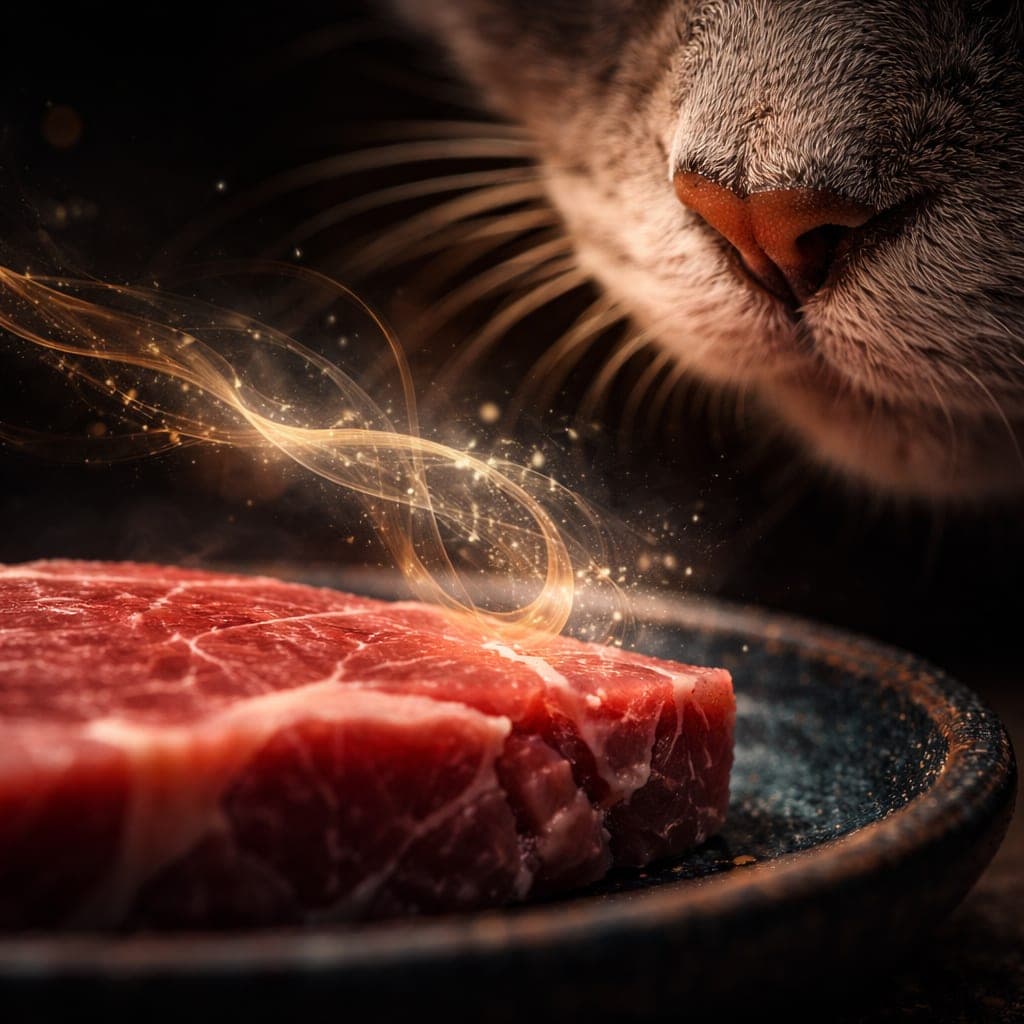
From the perspective of a cat's nose (equipped with 200 million olfactory receptors), warm food smells more like meat and less like old fat. A signal practically ideal for an obligate carnivore.
Cold food? The volatile compounds stay "locked in" — the nose gets a much weaker, muffled message. The cat doesn't really know what's in the bowl. And a cat that doesn't know what's in the bowl simply doesn't eat.
37°C: the temperature of a freshly caught mouse
The number 37°C isn't accidental. It's the average body temperature of mammals — the cat's natural prey.
- House mouse: 36.5–38°C
- Rat: 37.5°C
- Rabbit: 38.5–40°C
- Sparrow: 39–42°C
When a cat in the wild catches a mouse and eats it, the mouse is at about 37°C. It's warm, fragrant, releasing the full profile of volatile meat compounds — with the free amino acids and nucleotides to which feline taste receptors are practically perfectly tuned.
Warm (37°C) = freshly caught = safe = eat. Cold = long dead = potentially dangerous = don't eat. An instinct coded deeper than personal experience.
— Eyre & McGrane, 2022
The study proves that this mechanism works even in house cats well over ten years old that have never seen a live mouse in their lives.
Why do senior cats respond most strongly?
The researchers deliberately chose cats over 7 years of age. That's no accident — in older cats the temperature preference is especially strong. Why?
1. A fading sense of smell
With age, cats lose some of their olfactory receptors (much as humans do). An older cat that started with 200 million receptors may in reality have far fewer. Warmer food releases more volatile compounds, delivering a stronger stimulus. It's like turning up the radio volume for someone hard of hearing.
2. Declining appetite
Older cats often eat less because of a slower metabolism, hidden pain (e.g. in the teeth), or illness (e.g. kidney disease). Warming the meal doesn't solve the medical problem, but it compensates for the sensory deficit — a stronger signal from the nose can "break through" the lack of appetite.
3. Fewer taste buds
Cats already have dramatically few taste buds (about 480 vs. a human's 9000), and with age their number falls. The intensified aroma profile of warm food saves the day, because a cat judges food's appeal in large part through its nose, not its mouth.
How do we know it's not the "cold in the mouth"?
An important methodological question. Maybe cats simply dislike the feeling of icy food in the mouth (just as we dislike drinking icy water in freezing weather)?
The study completely eliminates this hypothesis. The cats made their decision to eat (or refuse) before they even touched the food with their tongue. They decided with their nose, from a distance. This is 100% consistent with earlier work (Hullár, 2001): if the smell of one bowl is sufficiently more appealing, the cat starts eating from it without even trying the contents of the other.
The full picture: how does this connect to other findings?
This study doesn't exist in a vacuum. It fits into a logical whole with other discoveries about the feline senses.
Umami and temperature
In 2023 it was proven that the feline "meat-taste" receptor (umami) responds most strongly to amino acids and so-called nucleotides (e.g. IMP, GMP) — the natural flavor enhancers found in muscle cells. Because these are volatile molecules, their release rises with temperature.
Warm meat releases the maximum umami. Cold meat keeps it trapped inside. That's why warm tuna drives a cat wild, while tuna straight from the fridge is sometimes ignored.
Oxidation and temperature
Hexanal is the main chemical marker of oxidation — the process of fat going rancid under the influence of oxygen. Cats detect it at concentrations completely ignored by the human nose (more on the feline nose and freshness markers in the article Why a cat rejects store-bought meat). Interestingly, the Eyre study showed that on warming, the level of released hexanal falls.
The feline nose gains twice over: a stronger "fresh meat" signal and a weaker "spoiled fat" signal.
Caveat
This only works with meat that is fresh to begin with. If we warm very old, heavily oxidized meat, the heat will release all the accumulated smells of spoilage, and the cat will reject it with redoubled force.
Practical tips at the bowl
For owners of senior cats
Your senior turning up its nose? Before you panic, warm the meal.
- Target temperature: about 37°C. The food should be pleasantly warm to the touch of your wrist, never hot.
- Method: Put the closed pouch/container into warm water for 2–3 minutes. You can use the microwave (5–10 seconds), but absolutely stir the meal after taking it out to avoid so-called hot spots (hidden, scalding points).
- Conclusion: If the cat eats eagerly after warming, the problem was fading senses. If it still refuses, the problem lies deeper and it's time to book a visit to the vet.
For those feeding a BARF diet
Raw meat straight from the fridge (~4°C) is an evolutionary signal: "old, cold corpse."
- Minimum: Take the portion out of the fridge 30 minutes before serving — let it reach at least room temperature (~21°C).
- Ideal: Submerge a sealed bag of meat in warm water for 5 minutes, aiming for 30–37°C.
Never above 40°C for raw meat
Above this temperature the proteins coagulate, and taurine — so precious for the feline heart — is washed out along with the released juices (plasma). If you're planning BARF, you can calculate the exact dose and supplementation in the mrumi BARF calculator.
When will warming NOT help?
Warming is a sensory trick, not a miracle cure. Urgently consult a vet if your cat:
- Refuses food entirely for more than 24 hours.
- Loses weight even though it's eating normally.
- Vomits shortly after eating a meal.
- Has a clearly altered (e.g. uremic) smell on its breath — which may suggest Chronic Kidney Disease (CKD) or dental problems.
Summary: a thermometer built into the genes
A mouse's body temperature is about 37°C. That's the temperature for which the feline senses optimized themselves over millions of years of evolution. That's exactly when meat smells precisely as a carnivore craves it.
Your cat isn't being spiteful or fussy when it rejects cold food. It's behaving exactly as it was designed to. It's a flawless machine for assessing a meal's freshness.
Next time your kitty looks at you with indignation over a cold bowl — just warm up its contents. And watch as biology gives it a resounding "YES."
Sources
- Eyre R., Trehiou M., Marshall E., Carvell-Miller L., Goyon A., McGrane S.J. Aging cats prefer warm food. Journal of Veterinary Behavior. 2022; 47:86–92.
- McGrane S.J. et al. Umami taste perception and preferences of the domestic cat (Felis catus), an obligate carnivore. Chemical Senses. 2023; 48:bjad026.
- Hullár I. et al. Factors influencing the food preference of cats. J Anim Physiol Anim Nutr. 2001; 85(7-8):205–211.
- Bartoshuk L.M. et al. Taste of water in the cat: effects on sucrose preference. Science. 1971; 171(3972):699–701.
Frequently asked
To what temperature should I warm wet food?
The target: about 37°C — pleasantly warm to the touch of your wrist, never hot. Put the closed pouch into warm water for 2–3 minutes. The microwave (5–10 seconds) works, but always stir the meal after taking it out to avoid hot spots.
Can I warm raw meat (BARF)?
Yes, but never above 40°C. Minimum: take the portion out of the fridge 30 min before serving (room temperature, about 21°C). Ideal: submerge a sealed bag of meat in warm water for 5 minutes, aiming for 30–37°C. Above 40°C the proteins coagulate and taurine leaches out with the juices.
My cat still won't eat after warming — what next?
Warming is a sensory trick, not a cure. If a cat refuses food for more than 24 hours, loses weight despite eating, vomits after meals, or has a uremic smell on its breath — go to the vet immediately. These signs may suggest CKD (chronic kidney disease) or dental problems.
Why do seniors respond more strongly to temperature?
With age, cats lose some of their 200 million olfactory receptors, have fewer of their already scarce 480 taste buds, and often a lower appetite (tooth pain, slower metabolism, illness). Warm food strengthens the signal from the nose — it's like turning up the radio volume for someone hard of hearing.
Does this also work for cold meat from the fridge if the cat is on BARF?
Yes — what's more, raw meat straight from the fridge (~4°C) is, for a cat, an evolutionary signal: 'old, cold corpse.' 30 minutes on the counter or 5 minutes in a warm bath (up to 37°C) is usually enough for the cat's senses to get the message: fresh, edible.