Your cat jumps onto your lap, curls into a ball and starts to purr. You feel that vibration in your chest, in your hands, in your legs — and everything seems clear: the cat is happy. Except that recent science has taken this "obvious" phenomenon apart piece by piece, and it turns out almost nothing about it is obvious. Purring is produced differently than we believed for half a century. It doesn't always mean contentment. And woven into its very sound is your cat's personal "signature."
I've gathered here only what follows from peer-reviewed research — from the physics of the larynx to behavior. No myths, but with a few genuinely surprising facts.
How purring is actually produced — the 2023 revolution
For over 30 years, textbooks were ruled by a single answer. It was formulated by Sissom, Rice and Peters (1991) in a paper with the telling title "How cats purr": purring was supposed to require active, cyclic tensing of the laryngeal muscles, driven by a signal from the brain dozens of times per second. In other words — the cat had to "consciously" pump out the sound.
In October 2023 that version fell apart. The team of phonetician Christian T. Herbst from the University of Vienna took isolated larynges of domestic cats (post mortem — after death, with no connection to the nervous system) and simply passed air through them.
25–30 Hz
All the examined larynges produced self-sustaining oscillations in the purring band — without nerves, without active muscle contraction. Purely mechanically.
The key turned out to be anatomy. A cat's vocal folds contain characteristic connective-tissue "pads" that increase the mass of the vocal cords and radically lower the frequency of vibration — down to a purring 25–30 Hz. It's the same myoelastic-aerodynamic mechanism (so-called MEAD, in which vibrations arise passively from the airflow itself) that underlies most mammalian voices, including human speech and a cat's meow.
What this changes — and what it doesn't
Herbst's study didn't prove the brain is entirely unnecessary — it only showed that a cat's larynx can purr passively, on its own. Active muscle tensing probably still tunes and sustains the sound. So the brain is more of a "pump switch" than a conductor beating out the rhythm.
Why so low — and who even purrs
Purring is exceptionally low: its fundamental tone lies below the lowest key on a piano. And not every cat can produce it.
Traditionally, the cat family was divided by the structure of the hyoid apparatus (the bones at the base of the tongue): the "roaring" cats of the genus Panthera — lion, tiger, leopard, jaguar — have this bone incompletely ossified, which lets them roar but not purr continuously. All the rest, the "purring" cats (including the house cat), have it fully ossified.
It's a classic hypothesis, but the nuance is worth knowing: researchers such as Weissengruber showed that the ability to roar is decided not so much by the hyoid bone itself as by the structure of the vocal folds and the length of the vocal tract. Interestingly, even the cheetah purrs — and very low, at around 20 Hz, just a few hertz lower than the house cat. Given the nearly twentyfold difference in body mass between these species, their purrs reach surprisingly similar frequencies.
And since even the cheetah purrs, while a lioness doesn't purr to her young — your house cat belongs to an elite "team" that the king of beasts can't match.
Purr number 1: "I'm fine and safe"
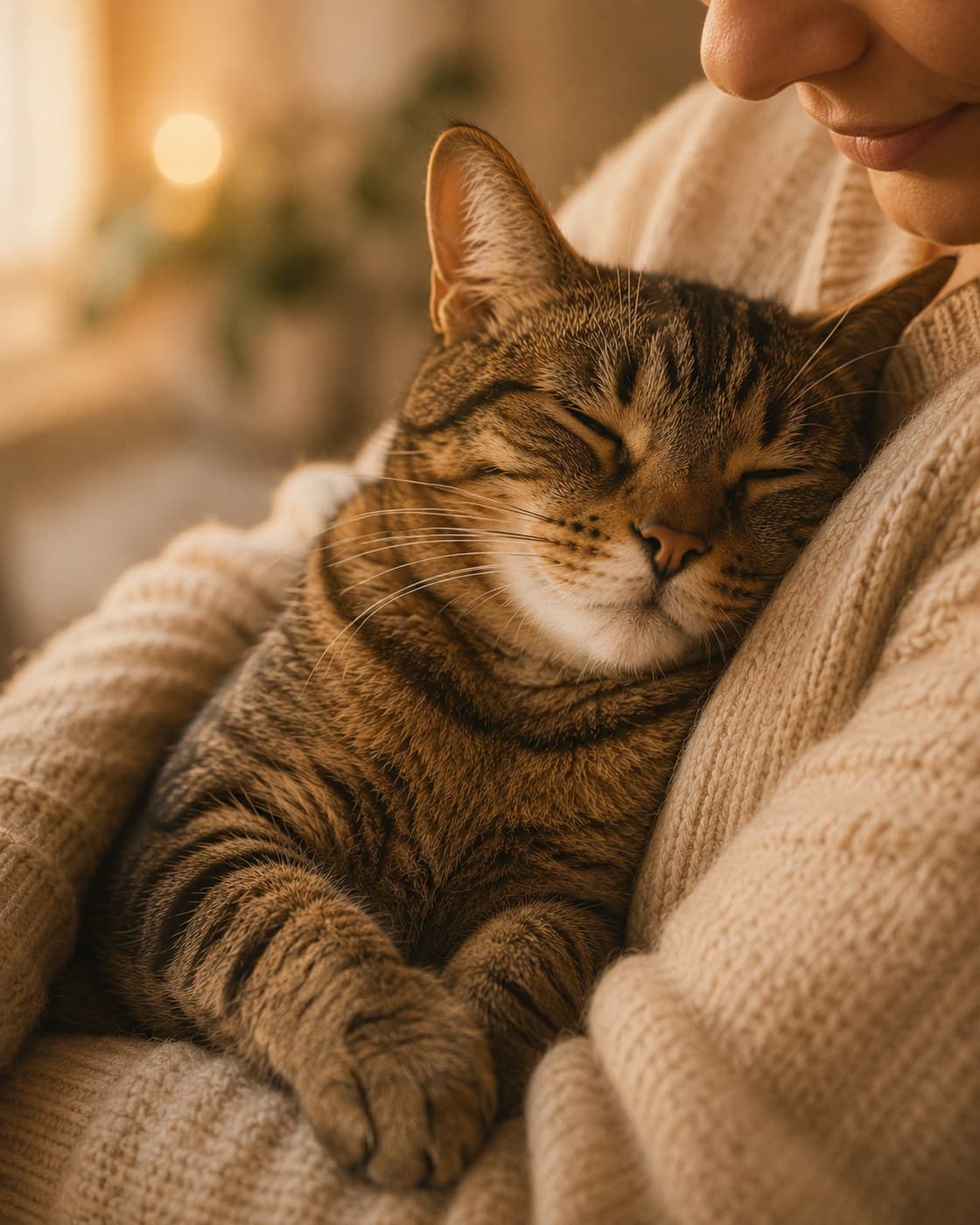
The most common context of purring is the one we know best: closeness, contact, calm. A kitten starts to purr in the very first days of life while suckling — and the mother purrs to her kittens. It's the first channel of communication in a cat's life, a signal of affiliation (that is, forming and maintaining a bond).
Importantly, it's purring — and not meowing — that is the "true" feline language of closeness. Adult cats rarely meow to one another; meowing developed mainly as a message directed at humans. The purr, meanwhile, works both between cats and in the cat–owner relationship, maintaining contact and signaling "there's no threat."
Purr number 2: the purr with a baby's cry hidden inside
And now one of the cleverest tricks in the animal world. It turns out a cat can "smuggle" into its purr something our brain can't ignore.
Researchers at the University of Sussex (McComb et al., 2009) recorded cats purring in two situations: when they were demanding food and when they were purring calmly. Then they played the recordings to people.
Even people who had never owned a cat rated the "food-soliciting purrs" as more urgent and less pleasant — even though they were objectively just as loud as the calm purrs.
— McComb et al., 2009, Current Biology
Where does the difference come from? In the "soliciting purr" the cat adds a high-frequency sound element in the 220–520 Hz band — pressed into the low, soothing purr. It's exactly the same range as a human baby's cry. When the researchers synthetically removed that component, the purr immediately stopped being perceived as urgent. The cat simply learns that this particular, slightly whining sound gets the bowl filled faster.
Purr number 3: cats also purr in pain and fear
Here begins the part that surprises many owners. Purring is not a reliable indicator of happiness. Cats also purr:
- at the vet, in the carrier,
- during birth,
- when they're sick or injured,
- and sometimes even while dying.
The most likely explanation is self-soothing — purring stabilizes breathing and rhythm, probably triggers a release of endorphins and helps the cat "get through" stress or pain. This isn't a contradiction with the contentment purr: in both cases the purr appears in situations where the cat needs to regulate its tension.
This is exactly where the famous healing-purr hypothesis comes from. Elizabeth von Muggenthaler (2001) noted that the dominant purring frequencies of cats overlap with ranges used in human vibration therapy.
'A cat heals by purring' — what's fact and what's over-interpretation
Be careful with over-interpretation. Von Muggenthaler's work is merely a conference abstract. The frequency range does match, but there are no clinical studies proving that being with a purring cat heals human fractures or wounds. What is real and well documented is something else: contact with a cat effectively lowers a person's mental tension and heart rate.
The purr as a "fingerprint" — your cat has a vocal signature
In December 2025, "Scientific Reports" published another counterintuitive study (Russo, Schild and Knörnschild). The researchers analyzed hundreds of meows and purrs, then asked an algorithm: how accurately can a given sound be assigned to a specific cat?
84.6% vs 63.2%
The purr turned out to be a far more reliable identifier than the meow.
It's counterintuitive, because surely the meow seems more flexible. And that's the crux: the cat negotiates the meow with its owner and tunes it to the situation. The purr stems from the anatomy of the larynx, staying stable — just like a person's unique voice timbre. Domestication simply made the meow more malleable, leaving the purr as a conservative, physiological signature.
Honestly: an individual purr ≠ a deliberate 'signature'
A note from the researchers themselves: the fact that a purr uniquely identifies a cat does not automatically mean cats deliberately use it to recognize one another. The differences may simply be a passive effect of each cat's individual laryngeal anatomy.
What it means at home — how to read your cat's purr
The most important practical lesson: read the context, not the sound alone.
- Contentment purr: relaxed body, soft posture, sometimes kneading with the paws, half-closed eyes. The signal: "I'm fine."
- Self-soothing (stress) purr: a hunched or tense body, ears turned to the sides, an objectively difficult situation. The signal: "I'm helping myself get through this."
- Soliciting purr: appears at the bowl, with that slightly whining, "urgent" tone.
What should concern you is a sudden change. A cat that suddenly stops purring, or starts purring a lot, tensely, in unusual situations, needs a vet's attention — it may be masking pain this way.
Next time your cat purrs on your lap, listen more closely. It's a sound shaped by ancient anatomy, carrying your cat's personal signature — and meaning far more than a simple "I'm happy."
References
- Russo D., Schild A.B., Knörnschild M. (2025). Meows encode less individual information than purrs and show greater variability in domestic than in wild cats, Scientific Reports 15:43490doi:10.1038/s41598-025-31536-7
- Herbst C.T., Prigge T., Garcia M., i wsp. (2023). Domestic cat larynges can produce purring frequencies without neural input, Current Biology 33(21):4727–4732doi:10.1016/j.cub.2023.09.014
- McComb K., Taylor A.M., Wilson C., Charlton B.D. (2009). The cry embedded within the purr, Current Biology 19(13):R507–R508doi:10.1016/j.cub.2009.05.033
- Frazer Sissom D.E., Rice D.A., Peters G. (1991). How cats purr, Journal of Zoology 223:67–78doi:10.1111/j.1469-7998.1991.tb04749.x
- Peters G. (2002). Purring and similar vocalizations in mammals, Mammal Review 32(4):245–271doi:10.1046/j.1365-2907.2002.00113.x
- Weissengruber G.E., Forstenpointner G., Peters G., Kübber-Heiss A., Fitch W.T. (2002). Hyoid apparatus and pharynx in the lion, jaguar, tiger, cheetah and domestic cat, Journal of Anatomy 201(3):195–209doi:10.1046/j.1469-7580.2002.00088.x
- Eklund R., Peters G., Duthie E.D. (2010). An acoustic analysis of purring in the cheetah (Acinonyx jubatus) and in the domestic cat (Felis catus), Lund University, Working Papers in Linguistics 54↗
- Nicastro N. (2004). Perceptual and acoustic evidence for species-level differences in meow vocalizations by domestic cats and African wild cats, Journal of Comparative Psychology 118:287–296doi:10.1037/0735-7036.118.3.287
- Bradshaw J.W.S. (2016). Sociality in cats: A comparative review, Journal of Veterinary Behavior 11:113–124doi:10.1016/j.jveb.2015.09.004
- von Muggenthaler E. (2001). The felid purr: A healing mechanism? (abstrakt konferencyjny), Journal of the Acoustical Society of America 110(5_Suppl):2666↗
Frequently asked
Does purring always mean a cat is happy?
No. Most often yes — purring accompanies contact, stroking and rest. But cats also purr when they're afraid, in pain, sick, giving birth, and sometimes even while dying. It's also a self-soothing mechanism. So a cat's mood is determined not by the sound itself, but by the whole context: body posture, ears, tail and situation.
Is it true that a cat's purr heals bones and wounds?
It's a popular but still unproven hypothesis. Purring frequencies (~25–50 Hz) overlap with ranges used in human vibration therapy (von Muggenthaler 2001), but there are no clinical studies showing that being with a purring cat heals fractures or wounds in humans. What is real and well documented is the soothing effect of contact with a cat on a person — a drop in tension and heart rate.
Why does my cat hardly purr at all?
It's usually a matter of temperament, breed and individual differences, not a lack of attachment or illness. Some cats are simply quiet. What should concern you is a sudden change — a cat that used to purr and stopped, or purrs in a clearly tense, hunched posture. Then it's worth consulting a vet, because purring can also be a sign of discomfort.
Do big cats — lions, tigers — purr?
Not in the same sense as a house cat. The big cats of the genus Panthera can roar but don't purr continuously. All small cats do purr: the house cat, wildcat, lynx, puma, and even the cheetah. A lioness doesn't purr to her young — but a house cat does.
Will I recognize my own cat just by its purr?
Most likely yes, especially if you have two cats. A 2025 study showed the purr is so individual that an algorithm correctly assigns it to a specific cat in nearly 85% of cases. After years of living together, your ear recognizes it holistically — by timbre, rhythm and context.